Should You Register Your Trademark?

Tags

, , , , , ,

Clients often inquire whether it’s in their best interest to register their trademarks with the U.S. Patent and Trademark Office (“USPTO”).

The traditional short answer is: ”Yes, if at all possible, you should register your trademarks!” This advice has been widely echoed by qualified intellectual property attorneys.

The purpose of this post is to give you additional financial information with which you can decide whether to register your trademarks. Some lawyers will tell you it’s “expensive.” The same lawyers might tell other clients that it’s “not expensive.” I’ll provide some real numbers that you can actually put into your budget.

First, keep in mind that registration of  trademarks is not required. Common law rights arise naturally from actual use of a trademark. Generally, the first entity to either use a trademark in commerce or file an intent to use application with the USPTO has the ultimate right to use and registration. However, filing for and receiving a federal trademark registration on the Principal Register provides several advantages:

  • constructive notice to the public of the registrant’s claim of ownership of the mark;
  • a legal presumption of the registrant’s ownership of the mark and the registrant’s exclusive right to use the mark nationwide on or in connection with the goods and/or services listed in the registration;
  • the ability to bring an action concerning the mark in federal court;
  • the use of the U.S registration as a basis to obtain registration in foreign countries; and
  • the ability to file the U.S. registration with the U.S. Customs Service to prevent importation of infringing foreign goods.

Optimally, all trademark owners who consider their trademark a valuable business asset (…and, if not, why continue using the mark?) would like to obtain these advantages.  But registration is not free.  Here are some of the likely fees (based on the USPTO’s current Fee Schedule, last revised January 1, 2019) that you will face before and during the registration procedure:

Clearance Search – Before adopting and using a trademark, it’s advised that a trademark clearance search be performed to determine the availability of the trademark.  This will help determine whether there is another user already using the trademark, i.e. having superior rights in the trademark.  By performing an initial trademark clearance search, a business can avoid incurring liability for trademark infringement and avoid investing resources in a trademark which could be unusable because it infringes another’s trademark rights. Most attorneys will conduct a clearance search at their standard hourly rate. Expect the clearance search to cost $200-400.

A commercial research service like Thomson CompuMark, which conducts a search across numerous databases (federal, state, common law, business databases) will cost around $700.  Add attorney time to review and report on the results.

Application Filing Fee – The official filing fee ranges between $225-$400 (based on the goods/services selected, paper submissions cost more than applications filed online). Your attorney will charge a fee for the application preparation and filing, likely ranging between $400-$1000.

Response to Office Action – Office actions are letters from the USPTO that set forth the legal status of a trademark application. Typically, the examining attorney will set forth various requirements that the applicant must meet before an application can be approved for publication.  A majority of your attorney’s time in the application process will be spent reviewing and responding to the office action.

Looking into the future, you’ll want to keep in mind the renewal costs which will be paid after five (5) years. Expect to pay $500 for each class of goods and services that your trademark protects. (For example, if a band has registered its band name for both “musical services” and “t-shirts,”  it will be paying filing fees for two separate classes of protection. This applies to filing fees also.)

Notwithstanding the renewal costs, and assuming that no extensions, etc. are required, you’re looking at approximately $800-$1000 to file a federal application for one trademark protecting one class of goods/services. On top of the USPTO fees, you’ll be paying your trademark attorney for their time spent gathering information, preparing documents, filing the application and communicating with the USPTO.  Therefore, choosing a trademark attorney who provides excellent service at a lower cost can greatly enhance your bottom line. Also, these are just some of the more common fees you will face in registering your trademark…there may be additional filings/costs associated with your trademark registration, depending on the specifics of your trademark and the strategy of your attorney.

So, should you register your trademark??? The traditional answer still rings true…if fiscally possible, do it. Trademarks are valuable business assets that are typically far greater in value than any costs associated with registration. Always bear in mind that economies rise and fall, but trademark rights can continue indefinitely. Unfortunately, that means that spending less today to protect your trademark rights may allow another party to intervene and lock up important trademark rights for the future.  Also, be sure to consider how licensing opportunities might be affected should you not register your trademarks.

Final practical note:  Any time you claim rights in a mark, you may use the “TM” (trademark) or “SM” (service mark) designation to alert the public to your claim, regardless of whether you have filed an application with the USPTO.  It’s free and reinforces good habits among those wearing the “marketing” hat.

Indiana Trademark Registration

Tags

Clients often inquire whether they should register their trademarks at the State or Federal level.  Starting with the assumption that even small local businesses may encounter a challenge to their trademark in the future, I generally try to impress upon them the advantages of federal registration.  After all, many of my clients end up being very successful and seek to expand outside of Indiana’s borders. With the exponential growth of “e-commerce,” the Internet is providing opportunities for national and global expansion, even for the smallest Indiana businesses.  It is therefore important for businesses of all types and sizes to choose and protect their trademarks with care…often this can mean protection at BOTH the State and Federal level.

Here’s a quick primer on registration of a trademark in Indiana:

Flag_of_Indiana.svg

Trademarks are registered with the Indiana Secretary of State.

Registration of a trademark with the Indiana Secretary of State creates a legal presumption of the registrant’s ownership of the mark and the registrant’s exclusive right to use the mark in Indiana commerce in connection with the goods or services described in the application.  (A federal registration would protect your trademark in all 50 states.)

The Indiana Trademark Act (IC 24-2) protects words, phrases, symbols or designs, or any combinations thereof when they are used to distinguish the source of the goods or services rendered by one party from the goods or services of another party. Marks are checked against other marks registered in Indiana, but not against corporate, fictitious, or assumed names.

Indiana trademark rights arise from actual use of the mark in commerce, i.e. no “intent-to-use” applications.

A mark cannot be registered until it has been used in Indiana. Indiana defines a mark being “used” when it is placed in any manner on the goods or their containers or on the tags or labels affixed thereto, or when it is used to identify the services of one person and distinguish them from the services of others, and such goods or services are sold, otherwise distributed, or rendered in this state.

So what are some of the main benefits of state registration over federal registration?  It’s cheaper (State: $10/class vs. Federal $325/class) and quicker.  I’ve seen turnaround of weeks, not years as with the USPTO.  It can be a good remedy for a purely local entity.  State registration provides an increased level of trademark protection…at least you can claim protection on your “home turf.”  However, in the long run, I’d recommend that any entity which anticipates expanding outside of Indiana, particularly via Internet “e-commerce,” should seek federal trademark registration to best protect their valuable trademark rights.

I look forward to hearing from proponents of State registration…how has an Indiana State registration uniquely benefitted either you or your clients?

Avoiding Loss of Trademark Rights

Tags

,

You’ve spent time, energy and money developing and protecting your trademark …possibly even obtaining a federal trademark registration. Now what? Going forward, you need to be careful to avoid several pitfalls that can result in the loss of your valuable trademark rights. Set forth below are several important considerations you should think about to avoid losing your rights as you continue to use your trademark and enforce your trademark rights against third parties:

1. Failure to use the trademark. Since trademark rights are based on use, a trademark owner must continue to use the trademark properly in order to avoid forfeiture of rights by abandonment. Non-use occurs when a trademark owner stops using the mark and does not intend to resume use. Further, intention not to resume use may be inferred from a trademark owner’s failure to use the mark for three consecutive years. Once a mark is deemed abandoned, all rights to the trademark are lost.

2. Authorizing uncontrolled use of the trademark. Trademark rights can be lost if you license the trademark to others but don’t take adequate steps to monitor the style and quality of products or services associated with the trademark. After all, trademark law grants you exclusive use of the trademark in exchange for giving the consuming public a reliable indication of quality. If the level of quality falls below a certain level, you may be setting yourself up for cancellation of your trademark right.

3. Failure to enforce your rights against infringers. If you continually allow known infringers to violate your trademark rights, you effectively give up the right to challenge their use. While this might not result in cancellation of your registration, you are undermining your trademark by wilfully adopting a very narrow scope of protection.

4. Generic use. Generic use refers to the situation in which a trademark becomes so familiar that the distinction of the mark diminishes.  We’re all familiar with the following trademarks which were allowed to become generic over time: aspirin, escalator, linoleum. Rights to those trademarks were lost because appropriate steps were not taken to prevent the public from coming to regard the marks as generic products or services, rather than particular brand names.

If you have concerns about whether you are adequately protecting your trademarks, consider consulting a trademark professional who can help you implement procedures for maintaining and enforcing your rights.

Carrington College accused of providing Personal Training students with copies of exams in advance

Tags

, , , , ,

Plaintiff National Federal of Professional Trainers, Inc., headquartered in Lafayette, Indiana, brings this action to prevent, and obtain damages for, Defendant Carrington College’s unauthorized copying and distribution of NFPT’s proprietary Certified Personal Trainer (“CPT”) credentialing examinations. Carrington College is a for-profit educational institution headquartered in Sacramento, California.

The Complaint alleges that “Carrington had given students copies of confidential and proprietary NFPT examinations, and then quizzed students on the copied examination questions until students memorized the answers to each specific question.”

Stay tuned for updates.

National Federation of Professional Trainers, Inc. v. Carrington College, Inc.

Court Case Number: 4:18-cv-00047-JVB-JEM
File Date: Monday, July 2, 2018
Plaintiff: National Federal of Professional Trainers, Inc.
Plaintiff Counsel: Anthony E. Dowell, Richard T. McCaulley, Kenley Eaglestone of McCaulley Dowell
Defendant: Carrington College, Inc.
Cause: Copyright Infringement, Misappropriation of Trade Secrets, Breach of Contract, Fraud
Court: Northern District of Indiana
Judge: Joseph S. Van Bokkelen
Referred To: John E. Martin

Complaint:

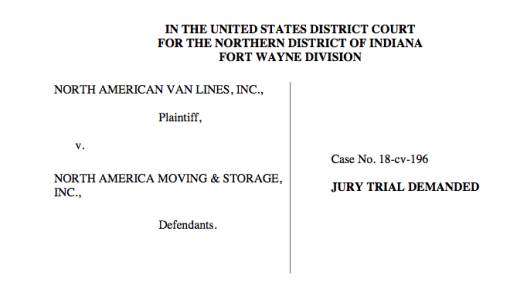
North American Van Lines sues North America Moving & Storage for trademark infringement, cybersquatting

Tags

, , , , , ,

The Plaintiff, North American Van Lines, has been providing transportation services since 1969. The Defendant, North America Moving & Storage, is accused of using a similar company name and domain names to infringe Plaintiff’s trademarks.

The Complaint (below) alleges instances of actual confusion.

Stay tuned for updates.

North American Van Lines, Inc. v. North America Moving & Storage, Inc.

Court Case Number: 1-18-cv-00196-TLS-SLC
File Date: Tuesday, June 26, 2018
Plaintiff: North American Van Lines, Inc.
Plaintiff Counsel: Mary A. Smigielski of Lewis Brisbois Bisgaard & Smith LLP
Defendant: North America Moving & Storage, Inc.
Cause: Federal Trademark Infringement, Federal Unfair Competition, Anticybersquatting Consumer Protection Act, Indiana Trademark Infringement, Common Law Unfair Competition
Court: Northern District of Indiana
Judge: Theresa L. Springmann
Referred To: Susan L. Collins

Complaint: