Source: Robert Milligan and summer associate Alana Friedman of Seyfarth Shaw LLP

A federal district court in Oregon recently granted a motion to stay in a dual-state non-compete matter based on the first-to-file rule, even though the two cases were filed only a few hours apart. The first-to-file rule provides that, when similar cases have been filed in different federal district courts, it is within the court’s discretion to dismiss the second filed action when it involves the same parties and issues.
In Biotronik, Inc. v. Guidance Sales Corp., 2009 WL 1838322 (D. Or. Jun. 22, 2009), Judge King of the United States District Court for the District of Oregon granted Guidant Sales Corporation’s (“GSC”) motion to stay against GSC’s competitor, Biotronik, Inc (“Biotronik”). The court granted the motion to stay based on the first-to-file rule. Id. at *3.
Biotronik and GSC are competitors in the distribution of cardiac rhythm management devices such as pacemakers and defibrillators. Biotronik is an Oregon corporation and GSC is an Indiana corporation with its principal place of business in Minnesota.

On April 10, 2009, twelve GSC employees ended their employment at GSC and began working at Biotronik. The employees signed agreements with GSC containing non-compete, non-solicit, and non-disclosure provisions. The agreements contained Minnesota forum and choice of law provisions.
On April 14, 2009, at approximately 12:26 p.m PDT, GSC filed suit in the United States District Court for the District of Minnesota seeking damages from Biotronik and the twelve defecting employees for allegedly breaching their employment agreements. GSC also alleged several employees breached their duty of loyalty as well as their non-disclosure and non-solicitation agreements. GSC further alleged that Biotronik tortiously interfered with GSC’s contract with its employees and aided and abetted the employees’ breach of their duty of loyalty to GSC. Finally, GSC sought a declaration that its non-compete agreement with each of the twelve employees was valid and enforceable and that Minnesota law applies.
Later that same day, Biotronik filed suit in Oregon state court at approximately 5:11 p.m. PDT (Biotronik apparently e-mailed the complaint to GSC at 3:42 p.m. PDT in advance of the filing). Biotronik sought a declaration that the twelve employees, and one additional former GSC employee also working for Biotronik, were in compliance with all of the “enforceable” restrictive covenants contained in the agreements they signed while employed by GSC. The former employees were not named parties to the action. The case was later removed to the federal district court in Oregon and assigned to Judge King.
On April 29, 2009, the Minnesota federal court entered a stipulated temporary restraining order and order for expedited discovery. The TRO required Biotronik to return confidential information and prohibited Biotronik from inducing the employees to solicit other GSC employees to leave. The employees were also prohibited from disclosing or retaining confidential information and soliciting current GSC employees to leave.
GSC then moved to have the federal case in Oregon dismissed or stayed under the first-to-file rule. The court found that the first-to-file rule was applicable because Biotronik and GSC are parties to both actions and the issues are substantially similar since both cases seek to determine the enforceability of the non-competition agreement. Id. at *2 (relying on Pacesetter Sys., Inc. v. Medtronic, Inc., 678 F. 2d 93, 94-95 (9th Cir. 1982)).
Although the court noted that rigid application of the first-to-file rule was not required, especially where the cases were filed only hours apart, it nevertheless chose to enforce the rule. The court provided two reasons as to why it was appropriate to grant the stay and allow the Minnesota case to proceed. Id. at *3. First, the Minnesota case would more thoroughly resolve the dispute because it involved more issues than the Oregon case. The court reasoned that Biotronik would still have to defend some of the charges in the Minnesota action even if the Oregon case proceeded. Second, the Minnesota action had progressed more quickly than the Oregon action since the parties in the Minnesota action had already agreed to a temporary restraining order and discovery had already begun. Id. The court also noted that Biotronik had not relied on any of the exceptions of the first-to-file rule, such as bad faith, anticipatory suit, and forum shopping. Id.(citing Alltrade, Inc. v. Uniweld Prods., Inc., 946 F.2d 622, 628 (9th Cir. 1991)) (emphasis added).
The court summed up its decision by stating that, “[i]n short, application of the first-to-file rule will promote the interest of judicial economy and avoid the possibility of conflicting judgments.” Id.
The case serves an important reminder that, depending upon the circumstances, filing suit first can make a difference when it comes to enforcing non-competition and non-solicitation covenants against former employees and their new employers, and vice versa. However, where there is demonstrated evidence of forum shopping, the court may decline to apply the “first-filed” rule.



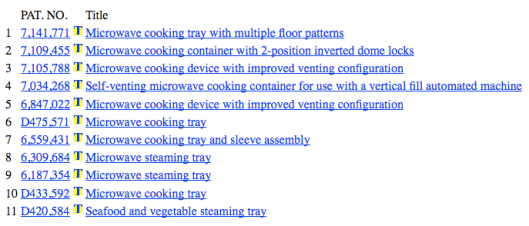
 In a suit filed in Scott County Superior Court, Gary Hopkins is seeking unspecified damages from the companies, which he claims ignored confidentiality agreements on his patented system using plastic containers with pinholes and steam vents to cut in half the time needed to microwave frozen food.
 That didn’t take long. The Indy Star

 So that’s it. Unless there’s another twist, this should be the end of this trademark litigation. The terms of settlement come so quickly after filing that it makes one wonder whether this could have been settled without filing a lawsuit. But perhaps putting this matter in the public eye is what drove one or both of the parties to settle. Nice work all around.
 Indiana Intellectual Property Blog