• Home
  • About
  • Contact
  • Disclaimer

Indiana Intellectual Property Blog

~ Trademark and Copyright Law Updates in Indiana

Indiana Intellectual Property Blog

Tag Archives: Fourth Estate

Copyright Office Registration Times: What the Current Numbers Mean

27 Tuesday Oct 2026

Posted by Kenan Farrell in Copyright, Federal Initiatives, Intellectual Property

≈ Leave a comment

Tags

Copyright, Copyright Office, Fourth Estate, Processing Times

The U.S. Copyright Office publishes processing-time data twice a year. For claims closed between April 1 and September 30, 2026, the average across all claims was 4.1 months. Fully electronic applications with an uploaded digital deposit and no examiner correspondence – the largest category – averaged 3.4 months, with a range of 1.2 to 5.5 months. Claims that required correspondence averaged 5.3 months. Applications with physical deposits or paper filings take longer on average.

The effective date of registration is not the date the certificate arrives. It is the date the Office receives a complete application, the required deposit, and the filing fee in acceptable form. That date is fixed once those three elements are in hand. Subsequent correspondence or examination time does not move it.

Under Fourth Estate Public Benefit Corp. v. Wall-Street.com, LLC, a copyright owner of a U.S. work generally cannot file a federal infringement suit until the Office has acted on the application. The processing-time numbers therefore affect when a suit can be filed, not when copyright protection itself begins. Protection attaches upon fixation. Registration is a precondition for most statutory remedies in federal court.

Special Handling remains available when a registration is needed for pending or prospective litigation, customs enforcement, or a contractual deadline. It requires a written explanation of the urgency and an additional fee. The broader Copyright Office fee schedule increases take effect November 11, 2026.

For Indiana photographers, designers, and businesses, the practical points are straightforward. File as early as possible if litigation is a realistic possibility. Respond fully and promptly to any examiner correspondence. Keep records of the filing date. The certificate will arrive later; the effective date does not.

Stay tuned for new Indiana copyright and trademark lawsuits.

Copyright Registration Before You Sue (and Why Photographers Keep Learning This the Hard Way)

08 Thursday Oct 2026

Posted by Kenan Farrell in Copyright, Intellectual Property, Litigation

≈ Leave a comment

Tags

Copyright, Fourth Estate, Indiana, Photography, registration, statutory damages

A photographer in Indianapolis shoots a wedding, a storefront, a plate of food. The picture shows up on someone else’s website. A friend says “send a cease-and-desist.” Another friend says “sue them.” Both friends skip the part that actually matters under the Copyright Act: for a United States work, you generally cannot file a civil infringement suit until the Copyright Office has registered the work. Not applied. Registered.

That is §411(a). The Supreme Court closed the “I filed the application last Tuesday” loophole in Fourth Estate Public Benefit Corp. v. Wall-Street.com. The certificate has to issue, or the Office has to refuse the application. An online deposit and a credit-card receipt are not a registration.

Two clocks, not one

Registration gets you in the courthouse door. A timely registration is what gets you statutory damages and attorneys’ fees under §412.

Timely means the registration was made before the infringement started, or within three months after first publication. Miss that window and you can still sue for actual damages and profits – if you can prove them. Proving what one scraped JPEG was worth, and what the restaurant actually made because of it, is how a $750 problem becomes a $15,000 problem that you cannot recover.

This is the part photographers keep learning the hard way. The picture was published on a portfolio site in March. The scrape happened in November. The registration was filed in December, after the angry email. The suit is allowed once the certificate issues. The statutory-damages count is not.

What “register the work” actually means

You register the photograph, or the group of photographs, not the business name and not the camera. Unpublished photos can go in as a group. Published photos have their own group option if they were published in the same calendar year and you meet the Office’s rules. A wedding gallery is not automatically one work. A year’s Instagram feed is not automatically one work.

The deposit has to be the work you intend to sue on. A low-res web crop of a different edit is how people pick fights with the Office that they did not need.

Foreign works have a different path into court. Most of the complaints this blog sees in the Southern and Northern Districts are U.S. photographs, U.S. software, U.S. text. Those need the certificate.

The cease-and-desist is not a substitute

A letter can ask the other side to take the picture down. It can preserve a claim. It cannot manufacture a registration date you do not have. If the plan is federal court, file the application first and wait. The Office is faster than it used to be. It is not same-afternoon fast.

If the plan is only a takedown, a registration still helps. Platforms and hosts are more likely to act on a registration number than on a caption that says “© 2026.”

What this blog will keep watching

When a copyright complaint lands in Indianapolis or Hammond and the registration dates are in the complaint – they usually are – those dates tell you which remedies are even in play. A complaint that pleads statutory damages on a work registered after the scrape is making a claim the statute does not give it. That is a drafting problem, not a jury problem.

Register the pictures you care about. Do it when you publish them, or at least within three months. Then worry about the letter.

Stay tuned for the docket updates.


Kenan L. Farrell, KLF Legal, Indianapolis

Supreme Court confirms that works must be registered before commencing copyright lawsuit

05 Tuesday Mar 2019

Posted by Kenan Farrell in Copyright, Intellectual Property, Legislation, Litigation, Supreme Court

≈ Leave a comment

Tags

Fourth Estate, Special Handling

Screen Shot 2019-03-05 at 8.07.53 AM.png

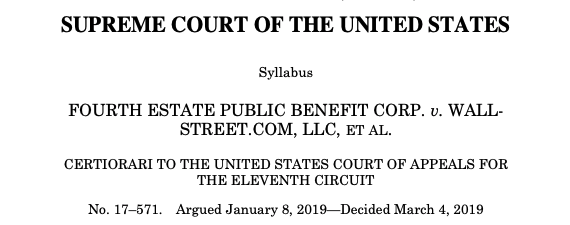
The much-anticipated ruling for Fourth Estate Public Benefit Corp. v. Wall-Street.com, LLC, et al. has arrived. Yesterday, Justice Ruth Bader Ginsburg delivered the opinion for a unanimous Supreme Court, confirming that a work must be registered prior to commencing a copyright infringement lawsuit.

Held: Registration occurs, and a copyright claimant may commence an infringement suit, when the Copyright Office registers a copyright. Upon registration of the copyright, however, a copyright owner can recover for infringement that occurred both before and after registration.

This ruling confirms the literal reading of 17 U.S.C. §411(a), which states that “no civil action for infringement of the copyright in any United States work shall be instituted until … registration of the copyright claim has been made in accordance with this title.”

Fourth Estate, a news organization, had argued that, because “registration is not a condition of copyright protection” under 17 U.S.C. §408(a), then §411(a) should not bar a copyright claimant from enforcing that protection in court once they have applied for registration.

Now it is clear that registration must be obtained before commencing a lawsuit. This means that copyright owners must be even more diligent about filing applications for their significant works. The time spent waiting on an application to register would normally remove any option of quick, decisive action by a copyright owner against an infringer.

The best option for late applicants will be the Copyright Office’s Special Handling procedure, which allows for registration in less than a week for an additional $800 Special Handling fee.

Justice Ginsburg’s opinion acknowledged the current administrative delay of the Copyright Office, acknowledging that Congress is in the best position to protect copyright claimants, either by increasing funding to the Copyright Office or revising the language of §411(a).

True, registration processing times have increased from one to two weeks in 1956 to many months today. Delays, in large part, are the result of Copyright Office staffing and budgetary shortages that Congress can alleviate, but courts cannot cure. Unfortunate as the current administrative lag may be, that factor does not allow this court to revise §411(a)’s congressionally composed text.

This blog will begin to monitor the real-world impact of this decision and report back periodically.

Categories

  • Advertising Law (1)
  • Artists (23)
  • Authors (20)
  • Bloggers (37)
  • Branding (29)
  • Business Law (9)
  • Copyright (333)
  • Dear KLF Legal (4)
  • Defamation (5)
  • Entertainment Law (14)
  • Estate Law (2)
  • Family Law (2)
  • Fashion (5)
  • Federal Initiatives (35)
  • Indiana (609)
  • Indianapolis (52)
  • Intellectual Property (673)
  • Just for Fun (25)
  • KLF Legal (19)
  • Legislation (34)
  • Litigation (602)
  • Musicians (13)
  • Nonprofit (6)
  • Northern District of Indiana (217)
  • Patent (44)
  • Privacy (15)
  • Right of Publicity (8)
  • Social Media (56)
  • Southern District of Indiana (371)
  • Stories from the Week that Was (42)
  • Supreme Court (13)
  • Tech Developments (119)
  • Trade Dress (26)
  • Trade Secret (15)
  • Trademark (370)
  • What I'm Reading (8)

Bloggers Copyright Federal Initiatives Indiana Indianapolis Intellectual Property Legislation Litigation Northern District of Indiana Patent Social Media Southern District of Indiana Stories from the Week that Was Tech Developments Trademark

Blog at WordPress.com.

  • Subscribe Subscribed
    Indiana Intellectual Property Blog

    Have a WordPress.com account? Log in now.

  • Indiana Intellectual Property Blog
    View site in Reader
    Manage subscriptionsSign upLog in
    Report this content
    Collapse this bar
Loading Comments...