Indiana Trademark Litigation Update – Situs Inc. v. Situs Realty

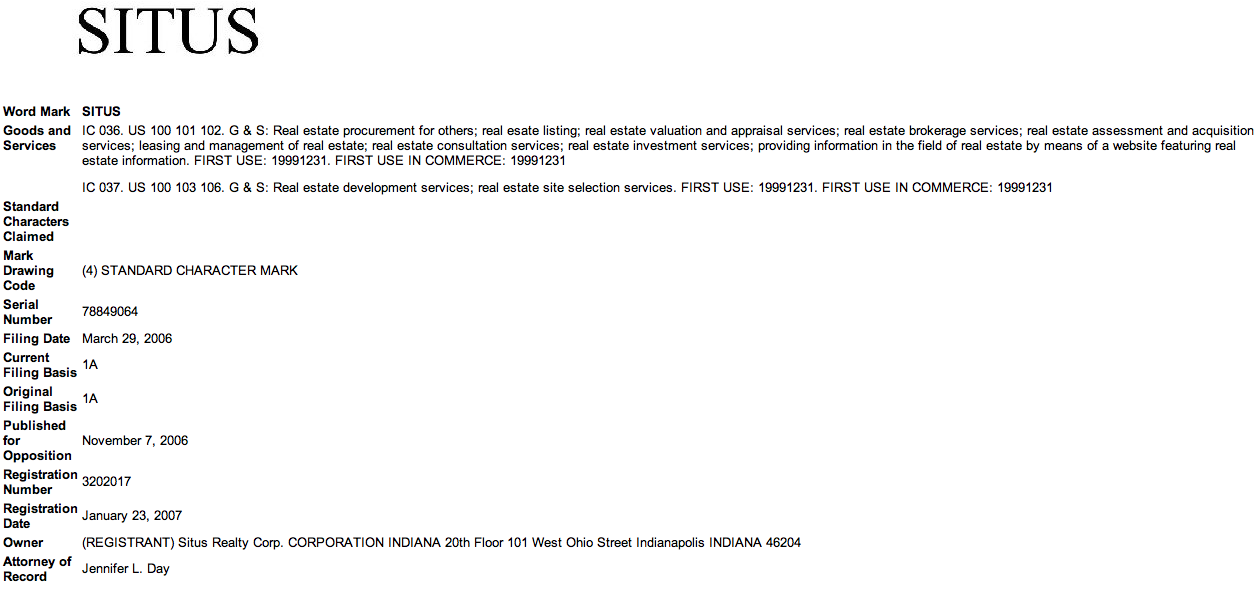
Indianapolis — Texas-based Situs Inc. has filed a federal lawsuit in Indianapolis claiming Situs Realty in Greenwood is infringing on the name the two real estate companies share. Talks have failed to find a settlement to their joint claims to the name.

The Houston-based company claims to have used the Situs name for 25 years.

However, Keith Stark, president of the Greenwood company, said he applied for and received a federal trademark on the Situs name in 2007 and that the Texas company failed to object at that time.

Situs trademark abstract:


More to come.

Source: Indy Star

What Could Have Been Entering the Public Domain on January 1, 2010?

Current US law extends copyright protections for 70 years from the date of the author’s death. (Corporate “works-for-hire” are copyrighted for 95 years.) But prior to the 1976 Copyright Act (which became effective in 1978), the maximum copyright term was 56 years (an initial term of 28 years, renewable for another 28 years).  Under those laws, works published in 1953 would be passing into the public domain on January 1, 2010.

This includes:

  • Ray Bradbury’s Fahrenheit 451
  • C.S. Lewis’s The Silver Chair (the fourth book in The Chronicles of Narnia)
  • Walt Disney’s Peter Pan
  • H.G. Well’s The War of the Worlds
  • From Here to Eternity (starring Burt Lancaster, Montgomery Clift, Deborah Kerr, Frank Sinatra, and Donna Reed)

Click here for a full discussion and additional works.

Source: Center for the Study of the Public Domain

Honoring an author. Attorneys among those preserving Vonnegut’s memory.

This blog author was featured recently in an Indiana Lawyer article about an organization I’m involved with, the Kurt Vonnegut Memorial Library.

The Kurt Vonnegut Memorial Library Foundation is a public benefit, nonprofit organization championing the literary, artistic, and cultural contributions of the late writer, artist and Indiana native Kurt Vonnegut, Jr. The Library Foundation is creating a library that will also serve as a cultural and educational resource center, functioning as a museum, art gallery, and reading room for readers, writers, and students. In addition, the library will support language and visual arts education for the local community.

Click here for full story by Rebecca Berfanger, Indiana Lawyer.

U.S. Patent Office Announces Program for Accelerated Review of Green Technology Patent Applications

The U.S. Patent and Trademark Office (USPTO) recently launched the Green Technology Pilot Program to accelerate the development and deployment of green technologies, help create green jobs, and promote U.S. competitiveness in the clean technology sector. In the press release announcing the Pilot Program, the Under Secretary of Commerce for Intellectual Property and Director of the USPTO, David Kappos explained, “Every day an important green tech innovation is hindered from coming to market is another day we harm our planet and another day lost in creating green businesses and green jobs.”

According to its own statistics, the USPTO takes on average 30 months to issue an initial office action for green technology patent applications and approximately 40 months to make a final determination on the patentability of such applications. In the normal process, applications are taken up for examination based on their filing date. Recognizing that over a three and half year wait is too long in the green technology sector, the Pilot Program provides a mechanism for green technology patent applications to be advanced, out of turn, to examination without having to pay any additional fees or provide any additional examination support documentation. The USPTO estimates that this Pilot Program will reduce the examination time of these applications on average by one year.

The Pilot Program broadly defines the term “green technologies” as technologies that pertain to environmental quality, energy conservation, development of renewable energy resources, or greenhouse gas emission reduction. Despite this broad definition, the USPTO currently requires that a patent application be classified in one of 79 specific U.S. patent classifications outlined in the Pilot Program to be eligible.

The Pilot Program only applies to non-provisional utility applications filed prior to December 8, 2009 that have yet to be examined. Applications that are either filed after December 8, 2009 or already being examined are not eligible for the Pilot Program. The Pilot Program is set to expire on December 8, 2010 and the USPTO only guarantees that it will accept the first 3,000 petitions to make an application special under the Pilot Program. Thereafter, the USPTO will evaluate whether the Pilot Program should be extended based on the USPTO’s workload and available resources. Thus, time is of the essence for those wanting to take advantage of the Pilot Program.

While there are limitations on the number and type of claims that can be included in the application and a requirement that an applicant waive its right to object to a restriction requirement, the Pilot Program does provide an inexpensive mechanism to expedite the examination of a green tech patent application. Such an expedited examination can prove beneficial to those looking to enforce their patent rights as quickly as possible and/or those looking for funding options.

Source: Inside INdiana

The Official Notice of the Pilot Program can be found at 74 Fed. Reg. 64666 (Dec. 8, 2009) and the USPTO Press Release for the Pilot program can be found at www.uspto.gov/news/pr/2009/09_33.jsp.

Indiana Trademark Litigation Update – Vision Center Northwest, Inc. v. Vision Value

Vision Center Northwest, Inc. v. Vision Valuewhite
No: 3:07-CV-183 RM (November 3, 2009)
U.S. District Court, N.D. of Indiana
Before: Miller

TRADEMARK; ABANDONMENT (Where a trademark owner’s only use of a mark for ten years was in a white pages listing, that mark is deemed abandoned.)

Opinion (Miller): Plaintiff operated a vision business under the name Value Visions by Dr. Tavel, until 1996, when plaintiff changed its name to Dr. Tavel. Defendant changed its name to Vision Value in 2007, and Plaintiff promptly sued for trademark infringement. The parties both moved for summary judgment. Defendant contended that Plaintiff abandoned the Value Visions mark as a result of more than ten years of nonuse. Plaintiff contended that it used the mark in the white pages during the entire ten year period. The court held that Plaintiff’s white pages listing was not bona fide use, and that Plaintiff brought forth no other evidence to show use or intent to use. Accordingly, the court held that Plaintiff had abandoned the mark and granted summary judgment for Defendant.

Source: Willamette Law Online [Summarized by Anthony Halderman]

For full opinion:
2009 U.S.Dist.LEXIS 103680
2009 WL 3669647