What Could Have Been Entering the Public Domain on January 1, 2011?

Tags

, , , , , ,

Current US law extends copyright protections for 70 years from the date of the author’s death. But prior to the 1976 Copyright Act (which became effective in 1978), the maximum copyright term was 56 years (an initial term of 28 years, renewable for another 28 years).  Under those laws, works published in 1954 would be passing into the public domain on January 1, 2011.

This includes:

  • The first two volumes of J.R.R. Tolkien’s Lord of Rings trilogy: The Fellowship of the Ring and The Two Towers
  • Aldous Huxley’s The Doors of Perception
  • Dr. Seuss’ Horton Hears a Who!
  • Richard Matheson’s I Am Legend
  • Fredric Wertham’s Seduction of the Innocent, subtitled “The influence of comic books on today’s youth”
  • Tennessee Williams’ Cat on a Hot Tin Roof
  • C.S. Lewis’ The Horse and His Boy, the fifth volume of The Chronicles of Narnia
  • First issue of Sports Illustrated
  • Director Alfred Hitchcock’s Rear Window, starring James Stewart, Grace Kelly, Raymond Burr, and Thelma Ritter
  • White Christmas, starring Bing Crosby, Rosemary Clooney, and Vera Allen, featuring songs by Irving Berlin
  • I Got a Woman, (Ray Charles and Renald Richard)

While authors of famous and commercially successful works have incentive to renew the copyright for a second term of 28 years, statistics show that 85% of authors did not renew their copyrights (for books, the number is even higher – 93% did not renew).  This means that if the pre-1978 law were still in effect, about 85% of the works created in 1982 would enter the public domain on January 1, 2011. How amazing would that be?

“Imagine what that would mean to our archives, our libraries, our schools and our culture. Instead, these works will remain under copyright for decades to come, perhaps even into the next century. And for most of them – orphan works – that means they will be both commercially unavailable and culturally off limits, without any benefit going to a copyright holder.”

Click here for the full discussion and additional works.

Indiana Intellectual Property Litigation Summary – December 2010

The following Intellectual Property cases were filed in Indiana in December 2010. Another slow month but there was an interesting right of publicity case:

Northern District of Indiana

Coach, Inc. et al v. Diggz Clothing LLC et al (Trademark)

Southern District of Indiana

Traveler’s Joy Inc. v. Haycco, LLC (Trademark)

Patricia Day v. Wonderama Toys et al (Right of Publicity)

November – October – September – August – July

Text of California “E-personation” Law

Tags

,

California has an interesting social media-related law going into effect on Jan. 1. It seeks to prohibit certain acts of online impersonation. Is such a law necessary in Indiana? Can you think of some otherwise “legal” activities that might become criminal under this law?

Senate Bill 1411. Impersonation: Internet.

SECTION 1. Section 528.5 is added to the Penal Code, to read:

528.5. (a) Notwithstanding any other provision of law, any person who knowingly and without consent credibly impersonates another actual person through or on an Internet Web site or by other electronic means for purposes of harming, intimidating, threatening, or defrauding another person is guilty of a public offense punishable pursuant to subdivision (d).

(b) For purposes of this section, an impersonation is credible if another person would reasonably believe, or did reasonably believe, that the defendant was or is the person who was impersonated.

(c) For purposes of this section, “electronic means” shall include opening an e-mail account or an account or profile on a social networking Internet Web site in another person’s name.

(d) A violation of subdivision (a) is punishable by a fine not exceeding one thousand dollars ($1,000), or by imprisonment in a county jail not exceeding one year, or by both that fine and imprisonment.

(e) In addition to any other civil remedy available, a person who suffers damage or loss by reason of a violation of subdivision (a) may bring a civil action against the violator for compensatory damages and injunctive relief or other equitable relief pursuant to paragraphs (1), (2), (4), and (5) of subdivision (e) and subdivision (g) of Section 502.

(f) This section shall not preclude prosecution under any other law.

Here’s what the California government has to say about the new law:

Indiana Right of Publicity Litigation Update – Patricia Day v. Wonderama Toys et al

Tags

, , , ,

Patricia Day v. Wonderama Toys et al

Plaintiff Patricia Day is the lead singer of the Danish rockabilly band HorrorPops. Plaintiff claims a distinctive on-stage appearance, which combines:

(1) black hair meticulously done in 50’s pin-up fashion; (2) her retro hairstyle juxtaposed against conspicuous and heavily-applied black eye shadow and liner and deep red lipstick; (3) her form fitting ’50s-style pencil skirts that go just past the knees; (4) her full-color “sleeve tattoos” on both upper arms; and, most importantly (5) her distinctive instrumental extension of her personality: her giant tattooed upright bass.

Mattel allegedly created a Barbie doll using the likeness of Ms. Day without obtaining a license. In addition to being an unauthorized use of her likeness, the Barbie doll has caused Ms. Day particular anguish due to her feminist leanings and the confusion caused among peers and fans.

Why was this case filed in Indiana? Presumably to take advantage of Indiana’s right of publicity law, perhaps the most extensive right of publicity statute in the world, providing recognition of the right for 100 years after death, and protecting not only the usual “name, image and likeness,” but also signature, photograph, gestures, distinctive appearances, and mannerisms. Defendants Wonderama and Rainbow End are small Indiana toy stores (in Anderson and Daleville, respectively) that sold the allegedly infringing doll. Of course, the real targets of this lawsuit are Mattel (a Delaware corporation) and Hard Rock Cafe (a Florida corporation).

Did Mattel usurp Ms. Day’s likeness for the doll? You be the judge:

This should be an interesting case to follow step-by-step. Plaintiff has retained a few high-profile entertainment attorneys and we can expect Mattel and Hard Rock will do the same. I’ll keep you updated with each new filing. In the meantime, more images of Ms. Day for comparison sake:

Court Case Number: 1:10-cv-01689-RLY-MJD
File Date: Thursday, December 23, 2010
Plaintiff: Patricia Day
Plaintiff Counsel: John Tehranian and Peter Afrasiabi of ONE LLP
Defendants: Wonderama Toys, Rainbow’s End Collectibles, Mattel Corp., Hard Rock Cafe International (USA), Inc.
Cause: Infringement of Right of Publicity (Indiana Code 32-36), False Association and False Endorsement
Court: Southern District of Indiana
Judge: Judge Richard L. Young
Referred To: Magistrate Judge Mark J. Dinsmore

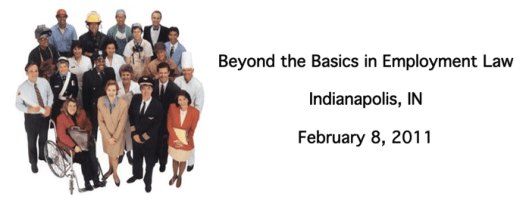
Upcoming Seminar – Beyond the Basics in Employment Law

It is essential to understand the emerging developments in employment law, as well as the distinction between employees and independent contractors. If your workers are properly classified, you can avoid the costly risks and looming penalties associated with worker misclassification. This seminar addresses issues “Beyond the Basics,” including Health Care Reform, Social Media and wage & hour classification crack down.

Speakers include an impressive team of attorneys who specialize in all aspects of labor and employment law at both the state and federal level. They have significant expertise in counseling clients on labor, employment, and human resources issues and representing employers in state and federal courts and administrative agencies.

Kenan Farrell will be speaking on the following topics:

III. Privacy, Social Media, and Employment Law in the Workplace: Balancing an employer’s right to know vs. employee privacy

  1. Whose computer is it? Monitoring Internet and e-mail
  2. Wireless devices and employee and employer privacy violations
  3. Monitoring and creating policies regarding electronic communications
  4. The use of social networking sites in the employment context (a. Employer risks with using social networking sites for employment decisions and b. Best practices and policies to minimize employer risk)
  5. Off the job behavior-blogging and dating
  6. Case law studies

This program has been approved by the Indiana Commission on Continuing Legal Education for 6.6 hours of CLE credit.

For more information and to register, please click here.