• Home
  • About
  • Contact
  • Disclaimer

Indiana Intellectual Property Blog

~ Trademark and Copyright Law Updates in Indiana

Indiana Intellectual Property Blog

Category Archives: Copyright

Indiana Copyright Litigation Update – Truth Publishing Company Inc. v. Kristopher C. Campbell

17 Monday Jan 2011

Posted by Kenan Farrell in Bloggers, Copyright, Indiana, Intellectual Property, Litigation, Northern District of Indiana

≈ Leave a comment

Tags

Christopher A. Nuechterlein, Copyright Infringement, Jon E. DeGuilio

Truth Publishing Company Inc. v. Kristopher C. Campbell

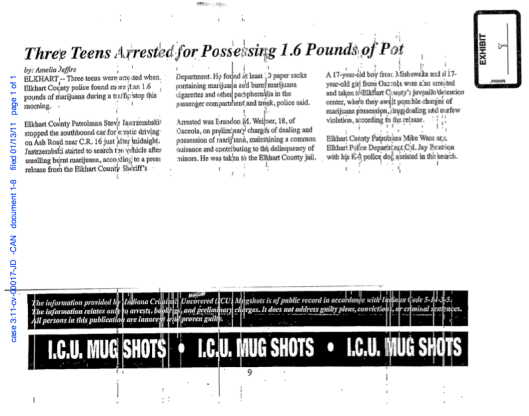
Plaintiff operates a daily newspaper called THE ELKHART TRUTH in Elkhart, Indiana. Defendant publishes a periodical called I.C.U. (Indiana Criminals Uncovered) MUG SHOTS. I.C.U. MUG SHOTS apparently copies news stories relating to crime and arrests directly from Plaintiff’s paper and sells the reprints for $1.50 a copy in Elkhart.

I can see why The Elkhart Truth would get tired of sending out its reporters to dig up info only to have another local paper photocopy their stories and republish. But, on some levels, isn’t Defendant doing a public service by helping spread information about criminals? Defendant certainly considered the copyright issues, as he included the following disclaimer:

“The information provided by Indiana Criminal Uncovered (ICU) Mugshots is of public record in accordance with Indiana Code 5-14-3-5. The information relates only to arrest, bookings, and preliminary charges. It does not address guilty pleas, convictions, or criminal sentences. All persons in this publication are innocent until provent guilty”

Whether the disclaimer can protect him will be determined by this lawsuit.

Defendant is running the old-school equivalent of a criminal law blog, which of course requires a little money for printing and distribution. Defendant is correct that mug shots and arrest records are public information. However, it appeared that Defendant copied the articles directly and distributed the reprints in the same geographic market, Elkhart.

While it’s likely that some people may not buy the Truth if they can get crime news from Defendant, there is apparently a wholly separate market of people who want crime stories but not the rest of the news content contained in a regular issue of the Truth. If so, Defendant may be able to continue to serve this audience, but will probably want to do more of his own fact-finding and reporting.
Court Case Number: 3:11-cv-00017-JD-CAN
File Date: Thursday, January 13, 2011
Plaintiff: Truth Publishing Company Inc.
Plaintiff Counsel: Steven M. Badger of Bose McKinney & Evans LLP
Defendant: Kristopher C. Campbell
Cause: Copyright Infringement
Court: Northern District of Indiana
Judge: Judge Jon E. DeGuilio
Referred To: Magistrate Judge Christopher A. Nuechterlein

View this document on Scribd

What Could Have Been Entering the Public Domain on January 1, 2011?

03 Monday Jan 2011

Posted by Kenan Farrell in Copyright, Intellectual Property, Legislation

≈ Leave a comment

Tags

Aldous Huxley, Copyright, Dr. Seuss, J.R.R. Tolkien, Lord of Rings Triology, Richard Matheson, Tennessee Williams

Current US law extends copyright protections for 70 years from the date of the author’s death. But prior to the 1976 Copyright Act (which became effective in 1978), the maximum copyright term was 56 years (an initial term of 28 years, renewable for another 28 years).  Under those laws, works published in 1954 would be passing into the public domain on January 1, 2011.

This includes:

  • The first two volumes of J.R.R. Tolkien’s Lord of Rings trilogy: The Fellowship of the Ring and The Two Towers
  • Aldous Huxley’s The Doors of Perception
  • Dr. Seuss’ Horton Hears a Who!
  • Richard Matheson’s I Am Legend
  • Fredric Wertham’s Seduction of the Innocent, subtitled “The influence of comic books on today’s youth”
  • Tennessee Williams’ Cat on a Hot Tin Roof
  • C.S. Lewis’ The Horse and His Boy, the fifth volume of The Chronicles of Narnia
  • First issue of Sports Illustrated
  • Director Alfred Hitchcock’s Rear Window, starring James Stewart, Grace Kelly, Raymond Burr, and Thelma Ritter
  • White Christmas, starring Bing Crosby, Rosemary Clooney, and Vera Allen, featuring songs by Irving Berlin
  • I Got a Woman, (Ray Charles and Renald Richard)

While authors of famous and commercially successful works have incentive to renew the copyright for a second term of 28 years, statistics show that 85% of authors did not renew their copyrights (for books, the number is even higher – 93% did not renew).  This means that if the pre-1978 law were still in effect, about 85% of the works created in 1982 would enter the public domain on January 1, 2011. How amazing would that be?

“Imagine what that would mean to our archives, our libraries, our schools and our culture. Instead, these works will remain under copyright for decades to come, perhaps even into the next century. And for most of them – orphan works – that means they will be both commercially unavailable and culturally off limits, without any benefit going to a copyright holder.”

Click here for the full discussion and additional works.

Superhero Law Debated on New Blog

21 Tuesday Dec 2010

Posted by Kenan Farrell in Bloggers, Copyright, Entertainment Law, Intellectual Property, Just for Fun, Trademark, What I'm Reading

≈ Leave a comment

Tags

Superhero

There’s a fun new blog, Law and the Multiverse, that applies real world law to comic book scenarios. In their words:

If there’s one thing comic book nerds like doing it’s over-thinking the smallest details.  Here we turn our attention to the hypothetical legal ramifications of comic book tropes, characters, and powers.  Just a few examples: Are mutants a protected class?  Who foots the bill when a hero damages property while fighting a villain?  What happens legally when a character comes back from the dead?

The blog touches on many different areas of law, including intellectual property. Here is an excerpt:

In the real world comic book characters and their likenesses have been made into toys, video games, movies, television shows, lunchboxes, bed sheets, and innumerable other things. All of these secondary uses are mediated through intellectual property rights, particularly copyright and trademark rights. But if Superman were a real person, how might the situation be different? Could just anyone slap his image or iconic S shield on a lunchbox? What about uses that suggest that Superman endorses a product or service? (“Try Metropolis Brewery Beer, the choice of the Man of Steel!”) Or worse, what about revealing a superhero’s secret identity?

Their latest post explores a favorite topic of the Indiana Intellectual Property Blog, privacy rights:

From a superhero’s point of view, the main issues here are intrusion into his or her secret identity and secret headquarters, if applicable.  The latter case is squarely within the scope of the tort (physical intrusion into a home or office is a classic example of the tort), so let’s focus on the issue of secret identity.  In particular, does a superhero’s secret identity fall under the scope of the second element?  And when we say “reasonable person” do we mean a reasonable regular person or a reasonable superhero, or does it matter?

The answer to the first question is probably yes.  Courts have held that the right to privacy includes psychological & emotional solitude and the intrusion can occur in a public place.  See, e.g., Phillips v. Smalley Maintenance Svcs, Inc., 435 So.2d 705, 711 (Ala. 1983) (holding “one’s emotional sanctum is certainly due the same expectations of privacy as one’s physical environment.” and “the ‘wrongful intrusion’ privacy violation can occur in a public place, when the matter intruded upon is of a sufficiently personal nature”).  As the definition states, the intrusion need not be directly physical and can include demands and threats.  Phillips, 435 So.2d at 711.

For the full post and to explore other areas of law, visit Law and the Multiverse.  One of the blog authors is a recent grad of Notre Dame Law School.  I’m looking forward to reading the future posts on copyright and trademark.

Indiana Copyright Litigation Update – BMI v. Shenanigans

01 Wednesday Dec 2010

Posted by Kenan Farrell in Copyright, Intellectual Property, Litigation, Musicians, Northern District of Indiana

≈ Leave a comment

Tags

Andrew P. Rodovich, Copyright Infringement, Litigation Update, Theresa L. Springmann

Broadcast Music Inc et al v. Shenanigans Inc et al

Defendant played 10 songs in his Anderson “Couples Only” establishment, Shenanigans, without a license from BMI, one of three main performance royalty organizations (along w/ ASCAP and SESAC). BMI claims to be caused “great” and “incalculable” damage. Actually, it’s probably about $0.25/song in the jukebox, but we know what they’re saying. While BMI seems like a cranky giant, it’s actually doing this on behalf of all of the artists it represents. Otherwise, nobody collects money and artists have to bring these lawsuits themselves.

Here are the songs allegedly infringed (listen to FULL PLAYLIST):

  1. Gimme Three Steps – Lynryd Skynyrd
  2. Hard to Handle – Black Crowes
  3. Inside Out – Eve 6
  4. Old Time Rock and Roll – Bob Seger
  5. Rocky Mountain Way – Joe Walsh
  6. Simple Man – Lynyrd Skynyrd
  7. Cumbersome – Seven Mary Three
  8. I Love This Bar – Toby Keith
  9. Linus and Lucy – Vince Guaraldi
  10. Bleed it Out – Linkin Park

Leave a comment or send an email if you’d like a full copy of the Complaint.

Court Case Number: 2:10-cv-00458-TLS -APR
File Date: Tuesday, November 16, 2010
Plaintiff: Broadcast Music Inc
Songs of Universal Inc
EMI Virgin Songs Inc
Rondor Music International Inc
Less Than Zero Music
Southfield Road Music
Fake and Jaded Music
Muscle Shoals Sound Publishing Co
PeerMusic III Ltd
Barn-Storm Music Inc
Belkin Music
EMI Blackwood Music Inc
Seven Mary Three Music
Sony/ATV Songs LLC
Big Yellow Dog LLC
Tokeco Tunes
Lee Mendelson Film Productions Inc
Universal Music-Z Tunes LLC
Chesterchaz Publishing
Rob Bourdon Music
Nondisclosure Agreement Music
Big Bad Mr Hahn Music
Kenji Kobayashi Music
Plaintiff Counsel: Christopher S. Riley of Barnes & Thornburg LLP
Defendant: Shenanigans Inc, Matthew Kelly
Cause: Copyright Infringement
Court: Northern District of Indiana
Judge: Judge Theresa L. Springmann
Referred To: Magistrate Judge Andrew P. Rodovich

Sarah Palin sues website for leaking excerpts of new book

22 Monday Nov 2010

Posted by Kenan Farrell in Bloggers, Copyright, Intellectual Property, Litigation, Social Media

≈ Leave a comment

Tags

Copyright, Copyright Infringement, Gawker Media, HarperCollins Publishers, Trademark Infringement

A federal judge on Saturday ordered Gawker Media to pull leaked pages of Sarah Palin’s forthcoming book “America by Heart: Reflections on Family, Faith and Flag” from its blog. Palin’s book will hit stores on Nov. 23.

The injunction prohibits Gawker from “continuing to distribute, publish or otherwise transmit pages from the book” pending a hearing on Nov. 30.
HarperCollins Publishers had sued Gawker after it published images on Nov. 17 from Palin’s book before its release next week.

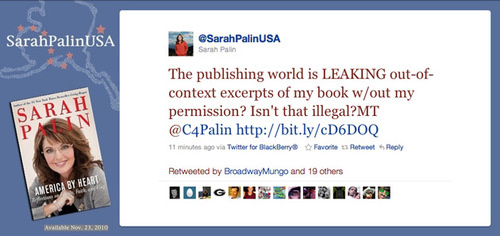
In response, Palin tweeted, “Isn’t that illegal?”

Gawker defended its action in a post Thursday titled “Sarah Palin is Mad at Us for Leaking Pages From Her Book” and addressed a message to “Sarah” telling her to read pages about fair use under copyright law. “Or skip the totally boring reading and call one of your lawyers,” the post said. “They’ll walk you through it.”

I’ll go a step further and save Sarah and everyone else the trouble of contacting a lawyer…Gawker’s posting of the pages was almost certainly a fair use.  “Fair use” is a limitation and exception to a copyright, the exclusive right to the author of a creative work.  The posting of excerpts for book reviews is an accepted practice and has been since at least 1961. The 1961 Report of the Register of Copyrights on the General Revision of the U.S. Copyright Law cites examples of activities that courts have regarded as fair use: “quotation of excerpts in a review or criticism for purposes of illustration or comment; quotation of short passages in a scholarly or technical work, for illustration or clarification of the author’s observations.”

There are four factors to be considered in determining whether or not a particular infringing use is “fair”:

  1. The purpose and character of the use, including whether such use is of commercial nature or is for nonprofit educational purposes
  2. The nature of the copyrighted work
  3. The amount and substantiality of the portion used in relation to the copyrighted work as a whole
  4. The effect of the use upon the potential market for, or value of, the copyrighted work.

Gawker may be considered to have a commercial interest in publishing the excerpts, via increased web traffic, ad sales, etc. However, they can claim an equally strong, if not greater, interest in criticism, comment, news reporting, teaching, scholarship or research (all “fair use” purposes). I wasn’t able to view the excerpts prior to their removal via the injunction but I understand it was not a substantial portion of the book. If anything, prior leaks only seem to enhance book sales. Would anyone be surprised if someone close to Palin’s camp was responsible for leaking the excerpts?

Presumably, it’s the nature of the “leak” prior to the book being on sale that has bothered Palin. But that’s also a common practice and most publishers consider it welcome free advertising leading into a big book launch. The next hearing is November 30, a week after the book release, so this may be a moot point by that time.

Sarah Palin’s main gripe may actually be with the excerpts being taken “out-of-context.” However, that wouldn’t be a copyright action, it would be an action for something like fraudulent misrepresentation (“If a statement of fact is made but the representor fails to include information which would significantly alter the interpretation of this fact, then a misrepresentation may have occurred.”). The Complaint isn’t available on PACER yet so I’m not sure what else it includes. Somebody send me a copy if you have it.

Copyright law has been abused in many ways by many industries recently, but hopefully this post will at least help restore sanity to the realm of book reviews.

[Update 11/23/10: I’ve been able to review the Complaint now. It’s available over on The Trademark Blog. Gawker posted 21 full pages from Palin’s book and that is almost certainly more substantial copying than you’d see in a typical review. Indeed, it may shift the fair use analysis over to Palin/HarperCollins. However, it also makes Palin’s comment of “out-of-context” seem silly…how do you take 21 full pages out of context?

The Complaint also dwells on Gawker’s own use of the word “leaked” as an admission of wilful infringement, probably poor word choice in retrospect and a lesson that newspapers learned long ago. We’ll see how this plays out once the book is released. Expect a mini-battle over revealing the source of the leak and, should it go that far, some data showing that the leak actually helped sales.]

Source: Associated Press

← Older posts
Newer posts →

Categories

  • Artists (23)
  • Authors (20)
  • Bloggers (37)
  • Branding (29)
  • Business Law (9)
  • Copyright (334)
  • Defamation (5)
  • Entertainment Law (14)
  • Fashion (5)
  • Federal Initiatives (35)
  • Indiana (610)
  • Indianapolis (52)
  • Intellectual Property (675)
  • Just for Fun (25)
  • KLF Legal (19)
  • Legislation (34)
  • Litigation (603)
  • Musicians (13)
  • Nonprofit (6)
  • Northern District of Indiana (218)
  • Patent (44)
  • Privacy (15)
  • Right of Publicity (8)
  • Social Media (56)
  • Southern District of Indiana (372)
  • Stories from the Week that Was (42)
  • Supreme Court (13)
  • Tech Developments (119)
  • Trade Dress (26)
  • Trade Secret (15)
  • Trademark (372)
  • What I'm Reading (8)

Bloggers Copyright Federal Initiatives Indiana Indianapolis Intellectual Property Legislation Litigation Northern District of Indiana Patent Social Media Southern District of Indiana Stories from the Week that Was Tech Developments Trademark

Blog at WordPress.com.

  • Subscribe Subscribed
    Indiana Intellectual Property Blog

    Have a WordPress.com account? Log in now.

  • Indiana Intellectual Property Blog
    View site in Reader
    Manage subscriptionsSign upLog in
    Report this content
    Collapse this bar
Loading Comments...