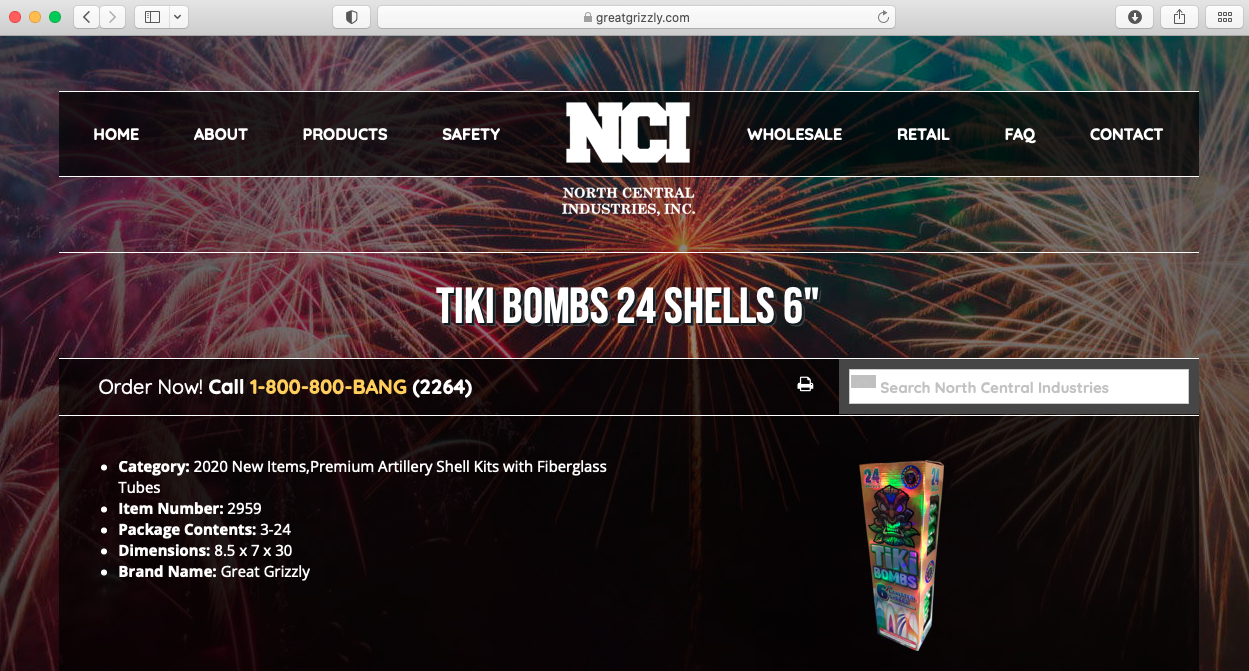
Happy New Year! It didn’t take long to get the first Indiana trademark (and trade dress) lawsuit of 2023, and in continuation of the festive celebrations, it involves fireworks.
The Defendants are alleged to be selling fireworks that infringe the Plaintiff’s registered TIKI, GHOST, and XL trademarks, as well as a “Tiki Trade Dress”.
The parties seem to be all major players in the fireworks industry, so they likely have some history. The Plaintiff has registered trademarks and it seems that the Defendants introduced new competing products utilizing similar marks after the registration date. As always, the Defendants’ Answer may tell another side of the story so stay tuned for updates.
1.4G Holdings, LLC v. North Central Industries, Inc. et al.
Court Case Number: 1:23-cv-00037-TWP-MG File Date: January 5, 2023 Plaintiff: 1.4G Holdings, LLC Plaintiff Counsel: Philip R. Zimmerly of Bose McKinney & Evans LLP Defendants: North Central Industries, Inc., Great Grizzly, Inc., R.Brown, Inc. Cause: Federal Trademark Infringement, False Designation of Origin, Trade Dress Infringement, Misappropriation Court: Southern District of Indiana Judge: Tanya Walton Pratt Referred To: Mario Garcia
Update 6/2/2021: I went to the grocery store today searching for Egg White Wraps and didn’t find any. Is this really a thing?
Here’s a fairly interesting trade dress lawsuit involving a food product I didn’t even know existed…egg white wraps. Apparently, egg white wraps were the “number one new product in dairy departments…in 2020” (see Complaint below). It begs the question, how many other new dairy products were released in 2020? Dairy product connoisseurs, please educate me in the comments below.
As general information, “trade dress” comprises the characteristics of the visual appearance of a product or its packaging that signify the source of the product to consumers. However, if trade dress is “functional,” meaning the characteristics are “essential to the use or purpose of the article or if it affects the cost or quality of the article,” it cannot serve as a trademark. See TMEP 1202.02(a).
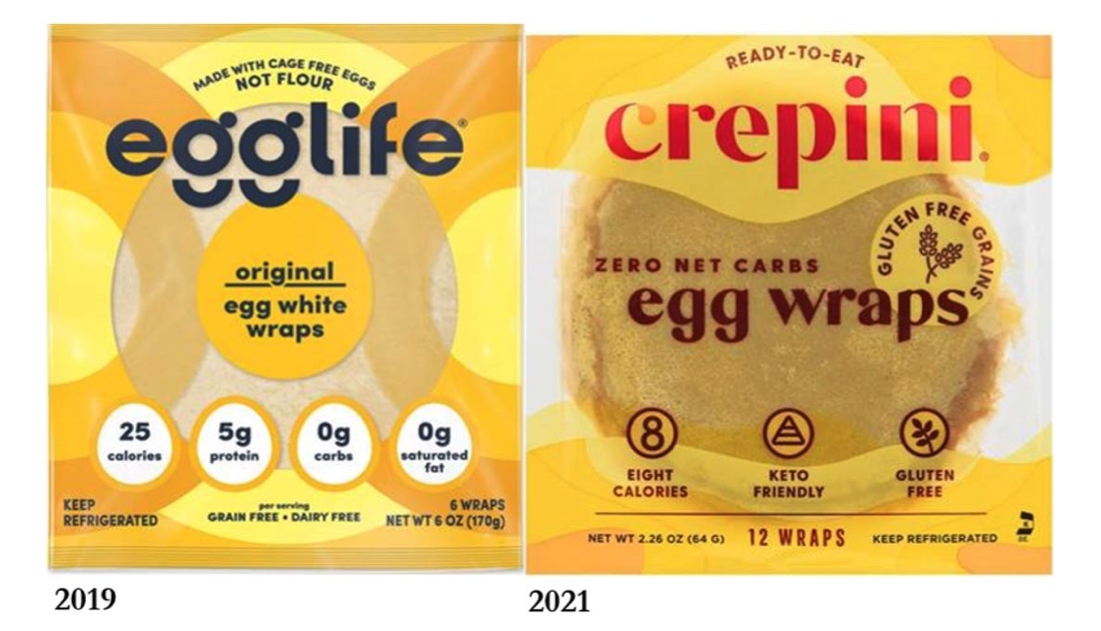
The Plaintiff in this lawsuit, Egglife, is accusing the Defendant, Crepini, of adopting packaging that is too similar to their own egg white wrap packaging.
Here are the specific elements that the Plaintiff consider to be their own protectable trade dress:
a. Interwoven and overlapping shapes with rounded rather than squared edges that weave in and out of the front of the package
b. The interwoven and overlapping shapes with rounded rather than squared edges are comprised of different, yellow-based colors
c. Transparent center window with overlaid graphics
d. Prominent display of “egg white wraps” in the center of the transparent window in the center of the front of the package
e. Lowercase “egglife”brand straight across the upper quarter of the front of the package
f. Smaller arched text centered over the “egglife” brand near the top of the front of the package
g. All capitalized“KEEP REFRIGERATED” text at bottom of the front of the package
h. Lowercase “egglife”brand straight across the upper quarter of the front of the package
i. Smaller arched text centered over the “egglife” brand near the top of the front of the package
j. All capitalized “KEEP REFRIGERATED” text at bottom of the front of the package
As mentioned above, I’m certainly no expert on egg white wrap packaging, but I have been in a grocery store before, and some/most of the above characteristics seem pretty standard for all types of food products. Food marketers please weigh in below, but many of these characteristics seem almost necessary, i.e. functional, given the limited packaging size for a small food product.
However, the Complaint highlights frequent changes to the Defendant’s packaging from early 2018 up to the 2019 rebrand to the current allegedly infringing packaging, of which the Defendant’s packaging now supposedly copies the characteristics of Plaintiff’s packaging:
a. Interwoven and overlapping shapes with rounded rather than squared edges b. The interwoven and overlapping shapes with rounded rather than squared edges are comprised of nearly identical yellow-based colors c. Transparent center window with overlaid graphics d. Lower case brand straight across the upper quarter of the packaging e. Smaller arched text centered over the top of the brand near the top of the packaging f. Abandoned trademarked EGG THINS in favor of “egg wraps” g. Abandoned the long-used CREPINI Iand crown design trademark in favor of lowercase font across the top of the packaging h. Added “Keep Refrigerated” messaging in all capital letters to the bottom of the packaging
As an unsophisticated egg white wrap consumer, both packagings frankly appear to me just like many other packagings in a grocery store. I’m reminded of flour tortilla packaging. Due in large part to FDA labeling requirements, food producers/marketers have to pack a lot of functional information about a product into a very small space. The use of the colors yellow and white in connection with an egg product seem to be almost a requisite. A transparent center window allowing a consumer to examine the food product seems highly necessary.
The Complaint does include some very limited evidence of instances of actual confusion by Costco consumers posting on Facebook. Considering the type of people that feel a need to post on social media about their Costco purchases, I’m not sure whether I’d consider those to be “significant” instances of confusion. However, they do exist and add an extra wrinkle to the lawsuit and Crepini’s possible defenses and responsibility to avoid consumer confusion.
This trade dress lawsuit will be interesting to follow. Stay tuned for updates.
Egglife Foods, Inc. v. Crepini, LLC
Case Number: 3:21-cv-00388 File Date: Friday, May 28, 2021 Plaintiff: Egglife Foods, Inc. Plaintiff Counsel: Louis T. Perry, David R. Merritt of Faegre Drinker Biddle & Reath LLP Defendant: Crepini, LLC Cause: Trade Dress Infringement, False Designation of Origin, Common Law Unfair Competition, Deception Court: Northern District of Indiana Judge: Jon E. DeGuilio Referred To: Michael G. Gotsch, Sr.
This is the second lawsuit filed by an energy drink company in a week!
The Plaintiff, Monster Energy Company, brings this lawsuit after several years of unsuccessful direct communications with the Defendant attempting to seek voluntary compliance with their asserted trademark rights.
Anybody who’s been to a gas station or watched the X Games will recognize the Monster “Claw Icon” logo, an “M-shaped claw design with jagged or irregular contours designed to evoke a claw having torn through the can or other material.” The Complaint (below) claims that Monster brand drinks are the best-selling energy drink in the United States. In October 2020, Monster was named the 4th Most Marketed Brand in Sports.
The Defendant, Bear KompleX, sells fitness equipment such as hand grips, weight belts, compression sleeves, and weight belts. They utilize a “Bear Claw” logo (not the donut) which looks like a slash (not the rocker) from a five-fingered bear paw. Bear KompleX’s logo often appears in various colors, including sometimes green and black.
Monster first contacted Bear KompleX in August 2019 demanding that they stop selling a “Grip, Calicure, & Doc Spartan Monster Bundle.” Later that month, Monster sent another letter warning Bear KompleX not to use a green claw mark. The Defendant apparently responded over the subsequent year by expanding its product offerings bearing a green claw mark, seemingly taunting Monster to take legal action.
That legal action has now been taken by Monster, and I’ll be looking forward to seeing Bear KompleX’s Answer. The Complaint asserts only a likelihood of confusion and no actual instances of confusion, so we can expect the Defendant to argue against any likelihood of confusion. They can point to differences between the logos, such as the Bear KompleX logo having five slashes, versus Monster’s three, and their bear claw facing upward rather than downward.
Stay tuned for updates.
Monster Energy Company v. R&R Medical, LLC d/b/a Bear KompleX
Case Number: 2:21-cv-00179-PPS-JPK File Date: Wednesday, May 26, 2021 Plaintiff: Monster Energy Corporation Plaintiff Counsel: James W. Riley, Jr., Jaclyn M. Flint of Riley Bennett Egloff LLP Defendant: R&R Medical d/b/a Bear KompleX Cause: Trademark Infringement, Trade Dress Infringement, False Designation of Origin, Federal Dilution, State Unfair Competition Court: Northern District of Indiana Judge: Philip P. Simon Referred To: Joshua P. Kolar
Evansville, Indiana-based Full Throttle Automotive, an auto repair shop, is being sued for trademark infringement by Energy Beverages, producer of Full Throttle energy drinks. The Complaint (below) highlights Energy Beverages’ long history of advertising in auto racing, including being the title sponsor of the National Hot Rod Association’s primary drag racing event.
The auto repair shop has also sponsored vehicles in motorsport events. Energy Beverages sent a cease-and-desist letter in October 2020, but Full Throttle Automotive has refused to discontinue use of its trademark.
Stay tuned for the Answer in the next few weeks, when we’ll likely find out how long Full Throttle Automotive has been using their “Full Throttle” name. They posted their current name and logo on Facebook back in 2014, and it’s likely they were using their name even before that, so they may have a strong acquiescence or laches defense based on many years of inaction from Energy Beverages.
A possible outcome could be a compromise whereby Full Throttle Automotive agrees not to sponsor NHRA events, presumably the most likely source of consumer confusion.
Energy Beverages LLC v. Full Throttle Automotive LLC
Case Number: 3:21-cv-00081-RLY-MPB File Date: Wednesday, May 19, 2021 Plaintiff: Energy Beverages LLC Plaintiff Counsel: James W. Riley, Jr., Jaclyn M. Flint of Riley Bennett Egloff LLP Defendant: Full Throttle Automotive LLC Cause: Trademark Infringement, Trade Dress Infringement, False Designation of Origin, Common Law Trademark Infringement, Unfair Competition Court: Southern District of Indiana Judge: Richard L. Young Referred To: Matthew P. Brookman
In the second gas station-related lawsuit this week, Speedway gas stations are accused of providing knock-off Chinese-manufactured Splenda, the well-known sugar substitute sweetener. For our health-minded blog readers who don’t touch the stuff or just crave real sugar, Splenda sweetener is actually sucralose, a low-calorie sugar-substitute first approved by the FDA in 1998.
Splenda’s manufacturer claims trade dress protection for sucralose sold in yellow packets, of which diner-frequenters, coffee and tea drinkers probably recognize:
Speedway is accused of providing knock-off Chinese sucralose sweetener in yellow packaging at their gas station coffee kiosks. The Plaintiff asserts that “Speedway’s yellow-colored packets are not provided to customers with sufficient cues to the consumer to prevent the mistaken belief by consumers that the yellow packets are in fact SPLENDA® Brand Sweetener.”
Blog readers, would you see the above packet at a coffee kiosk and automatically assume that it is Splenda®? If so, reach out to Plaintiff’s attorney, because that’s the basis of this lawsuit. (Aside: Did you know there are over 50 shades of yellow?)
Splenda’s manufacturer asserts trade dress infringement, unfair competition, false advertising, and dilution claims against Speedway. This will be an interesting case to follow, with both parties being fairly large companies, and presumably with Speedway gas stations already providing their yellow “knock-off” sweetener widely. Not being a coffee drinker (although married to one), I can only guess at what goes through the coffee drinker’s mind before consuming that cherished travel-sized cup of lukewarm gas station bitter brown water, but I really wonder if they are confused by the yellow packaging or whether they care at all. I suspect coffee drinkers grabbing a free packet of sweetener from a gas station kiosk don’t care at all what type of sucralose they’re ingesting, so long as the delivery medium is decently warm and caffeinated. Speedway’s packaging does not mention “Splenda” whatsoever, just listing ingredients of dextrose and sucralose. Apparently, it’s the use of the color yellow (but which yellow?) that bought Speedway this lawsuit.
A fairly easy potential compromise would be for Speedway to provide their sucralose sweetener in non-yellow packaging, but I’m guessing Speedway will decide to challenge Splenda’s asserted monopoly over the color yellow for sweeteners. Splenda’s arguably broad trade dress might need to be narrowed to a certain yellow shade (or shades), rather than the entire spectrum of yellow.
Either way, this lawsuit will be interesting to follow…stay tuned for updates.
Heartland Consumer Products LLC v. Speedway, LLC
Court Case Number: 1:21-cv-00322-JMS-TAB File Date: February 8, 2021 Plaintiff: Heartland Consumer Products LLC Plaintiff Counsel: Holiday W. Banta, Jessa DeGroote, Alice Kelly of ICE MILLER LLP Defendant: Speedway, LLC Cause: Trade Dress Infringement, Common Law Trade Dress Infringement, False Designation of Origin, Federal Unfair Competition, False or Misleading Representation of Fact, False Advertising, Common Law Unfair Competition, Federal Trademark Dilution, State Trademark Dilution Court: Southern District of Indiana Judge: Jane Magnus-Stinson Referred To: Tim A. Baker




 Indiana Intellectual Property Blog