Delta Faucet Company is going after Russian counterfeit faucet sellers in the Southern District of Indiana. In a lengthy and well-drafted Complaint (below), the Plaintiff details how a company’s trademarks are impacted by negative online marketplace reviews and unauthorized sellers. The lawsuit potentially exposes a gray market existing within Amazon’s “Fulfillment by Amazon” services that allows for counterfeit sales, leading to invalid product warranties, disgruntled consumers, and a damaged brand.
This lawsuit, along with Delta’s upgraded authorized seller policies (described in the Complaint), could serve as a good model for other companies dealing with online counterfeits. Although I predict the individual counterfeiters will simply disappear to continue on behind other aliases, Delta is likely more interested in getting an injunction to prevent further Amazon sales, setting precedent against counterfeiters and possibly allowing them to address the numerous unearned negative product reviews.
Stay tuned for updates.
Delta Faucet Company v. Iakovlev et al.
Court Case Number: 1:21-cv-00733-JRS-TAB File Date: March 25, 2021 Plaintiff: Delta Faucet Company Plaintiff Counsel: Louis T. Perry of Faegre Drinker Biddle & Reath LLP Defendant: Dmitrii Iakovlev, John Does 1-10 Cause: Federal Trademark Infringement, Federal Unfair Competition, Common Law Trademark Infringement, Common Law Unfair Competition, Indiana Crime Victim’s Relief Act, Deception Court: Southern District of Indiana Judge: James R. Sweeney II Referred To: Tim A. Baker
The Plaintiff in this trademark lawsuit, Vroom, is an online nationwide used car retailer based in New York, New York. own 8 U.S. trademark registrations for VROOM and the Vroom Logo, using the marks since at least 2014. The Plaintiff’s domain name is http://www.vroom.com.
The Defendants operate Vrooomsace, a used car retailer located in Indianapolis, Indiana. The Defendants’ use the domain name vrooomcars.com.
Asserting a likelihood of confusion, Plaintiff’s counsel first attempted to contact the Defendants on December 30, 2020, but apparently has received the runaround ever since, never receiving a substantive response from Defendants.
Their patience apparently has run out, resulting in this lawsuit. We’ll see whether Plaintiff finally gets a response. Unfortunately, often it takes a filed complaint for the opposing party to take a matter seriously. If not, this lawsuit could wind up with a default judgment.
Stay tuned for updates.
Vroom, Inc. v. Midwest Motors LLC et al.
Court Case Number: 1:21-cv-00715-TWP-TAB File Date: March 24, 2021 Plaintiff: Vroom, Inc. Plaintiff Counsel: David A.W. Wong, Caitlin R. Byczki, Kathleen S. Fennessy of Barnes & Thornburg LLP Defendant: Midwest Motors LLC dba Vrooomsace Car Selection, Khaled Alragwi Cause: Federal Trademark Infringement, Federal Unfair Competition, False Designation of Origin, Common Law Unfair Competition, Common Law Trademark Infringement, Anticybersquatting Consumer Protection Act Court: Southern District of Indiana Judge: Tanya Walton Pratt Referred To: Tim A. Baker
One company’s efforts to expand its LA MICHOACANA MEAT MARKET brand from meat markets to grocery stores has moved into Indiana.
The Plaintiff, La Michoacana Meat Market, owns several federal trademark registrations for LA MICHOACANA MEAT MARKET for “Retail meat market stores.”
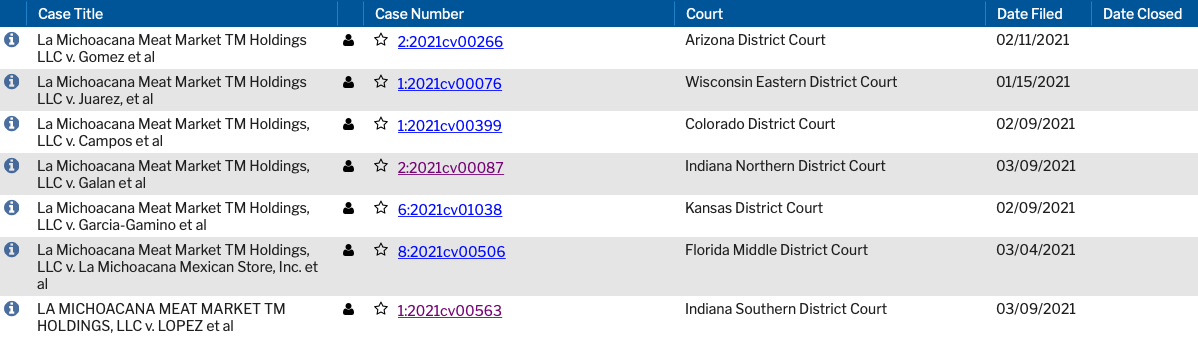
Seeking to claim undeniably broader protection over “LA MICHOACANA” in connection with grocery stores, the Plaintiff has brought numerous lawsuits over the last few years against small grocers using the term “Michoacana” (or some variation) in their name. Two new Indiana lawsuits are the 6th and 7th filed by La Michoacana against small grocers just this year.
“La Michoacana,” is a common term meaning someone or something from the state of Michoacán in western Mexico. Like an Iowan is from Iowa, or a Californian is from California (but not like a Hoosier is from Indiana). It is apparently a very popular term when naming “Mexican-themed grocery stores,” as evidenced by these lawsuits.
Due to the Defendants’ respective locations, one lawsuit was filed in the Southern District of Indiana and the other in the Northern District of Indiana. It will be interesting to track the two lawsuits side-by-side to see whether they reveal any significant differences between the Northern and Southern District.
Plaintiff’s Registered Mark
LA MICHOACANA MEAT MARKET for “Retail meat market stores”
Northern District Defendant’s Mark
CARNICERIA Y FRUTERIA LA MICHOACANA for a “Mexican-themed grocery store”
Southern District Defendant’s Mark
SUPER MERCADO JIREH POLLO MICHOACANO for a “Mexican-themed grocery store”
Between the two, I predict more difficulties for the Northern District Defendant. For some reason, the Northern District Defendant includes a link to the Plaintiff’s website on its Facebook page, which could be interpreted as evidence of intent to confuse or deceive. However, it’s not apparent from the Complaint (below) who added the link on the Facebook page, as it could be an incorrect Facebook-generated link or third-party edit.
Via this Google Maps image, the Northern District Defendant uses “La Michoacana” more prominently than the other literal elements of their brand (“Carniceria Y Fruteria”) on consumer-facing signage, which strengthens the Plaintiff’s argument for likelihood of consumer confusion.
Compare that to the signage of the Southern District Defendant, which uses the allegedly infringing term less prominently, and with a different spelling:
Further, the services seem different between the Northern and Southern District defendants, whereas the Northern District’s signage specifically advertises the sale of meats. Rather, the Southern District Defendant is a “tienda,” a small neighborhood grocery shop, different than a “retail meat market store.”
Perhaps in recognition of the possible narrow application of their “Retail meat market stores” description, La Michoacana has recently filed an additional federal trademark application for LA MICHOACANA SUPERMARKET for “Retail grocery stores.” That trademark application will be published for opposition on March 30, 2021, and might face challenges from among La Michoacana’s growing list of defendants.
The reality is that a single small grocery owner won’t want to spend much money defending their store name in federal court and will likely just choose to change the name, which the Plaintiff undoubtedly has considered. Buying new signage simply costs less than defending a federal lawsuit. Depending on how long each Defendant has been using their respective name, they may have a good acquiescence or laches defense.
Stay tuned for updates.
Sidenote: The LA MICHOACANA brand has also been the subject of a separate, but equally interesting, trademark dispute in connection with fruit popsicles.
La Michoacana Meat Market TM Holdings, LLC v. Lopez et al.
Court Case Number: 1:21-cv-00563-TWP-TAB File Date: March 9, 2021 Plaintiff: La Michoacana Meat Market TM Holdings, LLC Plaintiff Counsel: Ann O’Connor McCready, Neil R. Peluchette of Taft Stettinius & Hollister LLP Defendant: Josue Lopez, Supermercado Jireh LLC Cause: Federal Trademark Infringement, False Designation of Origin, Unfair Competition, Common Law Unfair Competition, Unjust Enrichment Court: Southern District of Indiana Judge: Tanya Walton Pratt Referred To: Tim A. Baker
La Michoacana Meat Market TM Holdings, LLC v. Galan et al.
Court Case Number: 2:21-cv-00087 File Date: March 9, 2021 Plaintiff: La Michoacana Meat Market TM Holdings, LLC Plaintiff Counsel: Ann O’Connor McCready of Taft Stettinius & Hollister LLP, Ruth M. Willars of Monty & Ramirez LLP (pro hac vice) Defendant: Cacimiro Galan, Carniceria y Fruteria La Morenita LLC Cause: Federal Trademark Infringement, False Designation of Origin, Unfair Competition, Common Law Unfair Competition, Unjust Enrichment Court: Northern District of Indiana Judge: Philip P. Simon Referred To: John E. Martin
In the second gas station-related lawsuit this week, Speedway gas stations are accused of providing knock-off Chinese-manufactured Splenda, the well-known sugar substitute sweetener. For our health-minded blog readers who don’t touch the stuff or just crave real sugar, Splenda sweetener is actually sucralose, a low-calorie sugar-substitute first approved by the FDA in 1998.
Splenda’s manufacturer claims trade dress protection for sucralose sold in yellow packets, of which diner-frequenters, coffee and tea drinkers probably recognize:
Speedway is accused of providing knock-off Chinese sucralose sweetener in yellow packaging at their gas station coffee kiosks. The Plaintiff asserts that “Speedway’s yellow-colored packets are not provided to customers with sufficient cues to the consumer to prevent the mistaken belief by consumers that the yellow packets are in fact SPLENDA® Brand Sweetener.”
Blog readers, would you see the above packet at a coffee kiosk and automatically assume that it is Splenda®? If so, reach out to Plaintiff’s attorney, because that’s the basis of this lawsuit. (Aside: Did you know there are over 50 shades of yellow?)
Splenda’s manufacturer asserts trade dress infringement, unfair competition, false advertising, and dilution claims against Speedway. This will be an interesting case to follow, with both parties being fairly large companies, and presumably with Speedway gas stations already providing their yellow “knock-off” sweetener widely. Not being a coffee drinker (although married to one), I can only guess at what goes through the coffee drinker’s mind before consuming that cherished travel-sized cup of lukewarm gas station bitter brown water, but I really wonder if they are confused by the yellow packaging or whether they care at all. I suspect coffee drinkers grabbing a free packet of sweetener from a gas station kiosk don’t care at all what type of sucralose they’re ingesting, so long as the delivery medium is decently warm and caffeinated. Speedway’s packaging does not mention “Splenda” whatsoever, just listing ingredients of dextrose and sucralose. Apparently, it’s the use of the color yellow (but which yellow?) that bought Speedway this lawsuit.
A fairly easy potential compromise would be for Speedway to provide their sucralose sweetener in non-yellow packaging, but I’m guessing Speedway will decide to challenge Splenda’s asserted monopoly over the color yellow for sweeteners. Splenda’s arguably broad trade dress might need to be narrowed to a certain yellow shade (or shades), rather than the entire spectrum of yellow.
Either way, this lawsuit will be interesting to follow…stay tuned for updates.
Heartland Consumer Products LLC v. Speedway, LLC
Court Case Number: 1:21-cv-00322-JMS-TAB File Date: February 8, 2021 Plaintiff: Heartland Consumer Products LLC Plaintiff Counsel: Holiday W. Banta, Jessa DeGroote, Alice Kelly of ICE MILLER LLP Defendant: Speedway, LLC Cause: Trade Dress Infringement, Common Law Trade Dress Infringement, False Designation of Origin, Federal Unfair Competition, False or Misleading Representation of Fact, False Advertising, Common Law Unfair Competition, Federal Trademark Dilution, State Trademark Dilution Court: Southern District of Indiana Judge: Jane Magnus-Stinson Referred To: Tim A. Baker
The Defendant in this lawsuit, a used car dealership management software company from Georgia, is accused of “repeated and brazen actions…designed to deceive and sow confusion in the marketplace.” Among the alleged actions of Defendant are illegitimate procurement of Plaintiff’s proprietary Run Lists (i.e. “lists containing information regarding automobile auctions”), use of a “bastardized” version of Plaintiff’s logo, and falsely claiming affiliation with Plaintiff.
The Defendant is also accused of inappropriately using Plaintiff’s AUTONIQ trademark in keyword advertising. The Defendant further used the AUTONIQ trademark in a deceptive email campaign which caused Plaintiff to receive inquiries from confused consumers.
Is it just me, or does the “bastardized” logo (see Complaint paragraph 23) actually look more like a goose rather than a “lower in quality” version of the Plaintiff’s eagle?
I’ll reserve judgment until the Answer is filed, as complaints can’t be relied on for the entire story, but this paints the picture of a Defendant who is willing to flout trademark law for a perceived competitive advantage.
Stay tuned for updates.
Adesa, Inc. and Autoniq, LLC v. Laser Appraiser, LLC
Court Case Number: 1:20-cv-02433-RLY-MJD File Date: September 21, 2020 Plaintiff: Adesa, Inc., Autoniq, LLC Plaintiff Counsel: Louis T. Perry of Faegre Drinker Biddle & Reath LLP Defendant: Laser Appraiser, LLC Cause: Federal Trademark Infringement, Federal Unfair Competition, Federal False Designation of Origin, Federal False Advertising, Common Law Unfair Competition, Indiana Crime Victim’s Relief Act, Conversion Court: Southern District of Indiana Judge: Richard L. Young Referred To: Mark J. Dinsmore