
Blog Author Featured in Indiana Lawyer Article

Check out this excerpt from an article in the current issue of the Indiana Lawyer (an IBJ Media publication), featuring none other than the author of the Indiana Intellectual Property & Technology Law Blog:

New-school Networking Ideas

…To help avoid having potential clients see personal information, attorneys on Facebook can also set up business profiles for their firms, which are separate from personal pages.

Kenan Farrell, a solo attorney in Indianapolis who represents artists and musicians among his list of intellectual property clients, said he has had success through his Facebook business page, Facebook ad – charged on a pay-per-click basis – and Twitter.

After he worked for a large firm in Indianapolis, he moved to San Francisco, then moved back to Indianapolis where he started his own firm in January.

He said it’s because of social networking that he’s been able to get “good, interesting work from clients” for much less than it would cost to have an ad on television or in the phone book, something he investigated when he decided to become a solo practitioner.

IndianaLawyerPictureSo far, most of the other attorneys on Facebook and Twitter he is connected to practice outside of Indiana. Those connections have resulted in business when lawyers in other states need local counsel or know someone who does.

Farrell also goes to networking events – “tweetups” – of others on Twitter. While he doesn’t think other attorneys have attended those meetings, he has met a number of business owners of various ages and experience.

Because business owners are on sites like Twitter, he said, it’s likely attorneys could benefit from connecting with them.

Twitter has also linked him to experts, and to large conferences where he was unable to attend but people in the conference were posting status updates.

While it’s not exactly the same, it can get the message out. For speakers, it can share their information with potentially hundreds or thousands of people beyond those in the room for the presentation.

While Farrell said he felt like “the only guy in the goldmine” by using Facebook and Twitter, he recommended it for all attorneys regardless of experience level for the benefits he has seen.

Click the images below to read the full article.
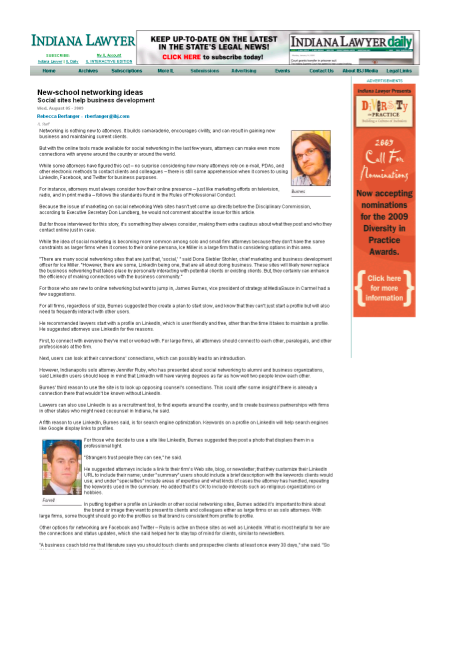
Picture 1Picture 2

Source: Indiana Lawyer, Vol. 20, No. 11


Blog Author Featured in Indiana Lawyer Article

Check out this excerpt from an article in the current issue of the Indiana Lawyer (an IBJ Media publication), featuring none other than the author of the Indiana Intellectual Property & Technology Law Blog:

New-school Networking Ideas

…To help avoid having potential clients see personal information, attorneys on Facebook can also set up business profiles for their firms, which are separate from personal pages.

Kenan Farrell, a solo attorney in Indianapolis who represents artists and musicians among his list of intellectual property clients, said he has had success through his Facebook business page, Facebook ad – charged on a pay-per-click basis – and Twitter.

After he worked for a large firm in Indianapolis, he moved to San Francisco, then moved back to Indianapolis where he started his own firm in January.

He said it’s because of social networking that he’s been able to get “good, interesting work from clients” for much less than it would cost to have an ad on television or in the phone book, something he investigated when he decided to become a solo practitioner.

IndianaLawyerPictureSo far, most of the other attorneys on Facebook and Twitter he is connected to practice outside of Indiana. Those connections have resulted in business when lawyers in other states need local counsel or know someone who does.

Farrell also goes to networking events – “tweetups” – of others on Twitter. While he doesn’t think other attorneys have attended those meetings, he has met a number of business owners of various ages and experience.

Because business owners are on sites like Twitter, he said, it’s likely attorneys could benefit from connecting with them.

Twitter has also linked him to experts, and to large conferences where he was unable to attend but people in the conference were posting status updates.

While it’s not exactly the same, it can get the message out. For speakers, it can share their information with potentially hundreds or thousands of people beyond those in the room for the presentation.

While Farrell said he felt like “the only guy in the goldmine” by using Facebook and Twitter, he recommended it for all attorneys regardless of experience level for the benefits he has seen.

Click the images below to read the full article.

Picture 1Picture 2

Source: Indiana Lawyer, Vol. 20, No. 11

President Obama Pledges $2.4 Billion for "Clean" Vehicle Technology

Speaking today at a former Monaco RV plant in Wakarusa, Indiana, President Barack Obama unveiled the details of an ambitious $2.4 billion grant program, which the White House hopes will boost production of electric cars and next-generation battery technology.  The cash for the grant program will come from the recently-passed $787-billion economic stimulus bill.

obama_indiana

“That’s why I’m here today,” President Obama stated, “to announce $2.4 billion in highly-competitive grants to develop the next generation of fuel efficient cars and trucks powered by the next generation of battery technologies, all made right here in the U.S. of A. Right here in America. Made in America…for too long, we’ve failed to invest in this innovative work, even as countries like China and Japan were racing ahead. That’s why this announcement’s so important.”

navistarThe President said the investment represented “the largest investment in this kind of technology in American history.” And already, dozens of companies have stepped forward to claim the grant money. One of them is Navistar, Inc., based in Wakarusa.  Navistar will receive a $39.2 million grant to develop and deploy 400 advanced battery electric delivery trucks. The vehicles will weigh about six tons and have a 100-mile range.”

The $2.4 billion in American Recovery and Reinvestment Act funds includes:

  • $1.5 billion in grants to U.S.-based manufacturers to produce batteries and their components and to expand battery recycling capability in the United States.
  • $500 million in grants to U.S.-based manufacturers to produce electric drive components for vehicles, including electric motors, power electronics, and other drive train components.
  • $400 million in grants to purchase thousands of plug-in hybrid and all-electric vehicles – including cars, delivery vehicles and trucks — for test demonstrations in several dozen locations. Those grants also will provide education and workforce training to support the transition to advanced electric transportation systems.

Source: The Christian Science Monitor, Indy Star

Indiana Space Travels Exhibit at State Fair, August 7-23

Indiana Space Travels

This year’s Indiana State Fair (starting this Friday, August 7) will go far beyond its popular farm-related exhibits to include a toast to the state’s contributions to space exploration.

The Indiana Space Travels exhibit opens Friday in the fairgrounds’ Grand Hall and runs throughout the fair, which ends Aug. 23.

The exhibit traces Indiana’s contributions to aeronautics, dating back to an 1859 hot air balloon flight from Lafayette that was the nation’s first airmail delivery.  The exhibit will also include a Mars roving unit, replicas of a space capsule and the Hubble Telescope, a modular mission control board and artifacts from various space missions.

Former NASA astronaut and Purdue University grad Mark Brown, who flew on two space shuttle missions, will attend Friday’s opening.

Source: Indiana Space Grant Consortium

Resources for Authors

As a primer for my upcoming workshop for authors, I’ll be writing a series of blog posts geared toward the wordsmiths among us.  To start things off, here’s a list of helpful online writing resources:

  1. Writer’s Digest – the No. 1 magazine for writers, celebrating the writing life and what it means to be a writer in today’s publishing environment.
  2. American Society of Journalists and Authors – the nation’s leading organization of independent nonfiction writers.
  3. The Author’s Guild – the nation’s leading advocate for writers’ interests in effective copyright protection, fair contracts and free expression since it was founded as the Authors League of America in 1912.
  4. National Writers Union – the union for freelance writers working in US markets.
  5. Poets and Writers, Inc. – the primary source of information, support, and guidance for creative writers, and the publisher of Poets & Writers Magazine.
  6. Author’s Coaching Network – online social network for authors.

And I’ll finish with a nod to my favorite author, Indianapolis-native Kurt Vonnegut, Jr., who left us too soon in 2007.  So it goes.

Vonnegut