• Home
  • About
  • Contact
  • Disclaimer

Indiana Intellectual Property Blog

~ Trademark and Copyright Law Updates in Indiana

Indiana Intellectual Property Blog

Author Archives: Kenan Farrell

Welcome to the new home of the Indiana Intellectual Property & Technology Blog

21 Friday Aug 2009

Posted by Kenan Farrell in Intellectual Property, KLF Legal

≈ Leave a comment

Welcome to the new home of The Indiana Intellectual Property & Technology Blog.  The blog has now permanently moved here from its former sub-domain (http://klflegal.wordpress.com).  Please make any necessary changes to your links/RSS feeds/etc.  The prior site will remain up for several weeks to allow everyone to make the switch.

Expect the same great content…Indiana-related legal and news updates for intellectual property law (patent, trademark, copyright, trade secrets, etc.) and technology issues.

Picture 1

Thanks, Kenan L. Farrell

Facebook, Twitter

Electronic Signatures on Online Forms – FormSpring Guest Blog

19 Wednesday Aug 2009

Posted by Kenan Farrell in KLF Legal, Tech Developments

≈ Leave a comment

Please check out my guest post over on FormSpring’s blog discussing the legal aspects of electronic signatures.

logo

FormSpring is a great company providing organizations with an easy way to build web forms that integrate with their websites without any programming, software, or special skills.

Oregon Court Grants Indiana Corporation's Motion To Stay In Non-Compete Matter

12 Wednesday Aug 2009

Posted by Kenan Farrell in Litigation, Trade Secret

≈ Leave a comment

Source: Robert Milligan and summer associate Alana Friedman of Seyfarth Shaw LLP

guidantlogo

A federal district court in Oregon recently granted a motion to stay in a dual-state non-compete matter based on the first-to-file rule, even though the two cases were filed only a few hours apart. The first-to-file rule provides that, when similar cases have been filed in different federal district courts, it is within the court’s discretion to dismiss the second filed action when it involves the same parties and issues.

In Biotronik, Inc. v. Guidance Sales Corp., 2009 WL 1838322 (D. Or. Jun. 22, 2009), Judge King of the United States District Court for the District of Oregon granted Guidant Sales Corporation’s (“GSC”) motion to stay against GSC’s competitor, Biotronik, Inc (“Biotronik”).  The court granted the motion to stay based on the first-to-file rule.  Id. at *3.

Biotronik and GSC are competitors in the distribution of cardiac rhythm management devices such as pacemakers and defibrillators. Biotronik is an Oregon corporation and GSC is an Indiana corporation with its principal place of business in Minnesota.

logo_biotronik

On April 10, 2009, twelve GSC employees ended their employment at GSC and began working at Biotronik. The employees signed agreements with GSC containing non-compete, non-solicit, and non-disclosure provisions. The agreements contained Minnesota forum and choice of law provisions.

On April 14, 2009, at approximately 12:26 p.m PDT, GSC filed suit in the United States District Court for the District of Minnesota seeking damages from Biotronik and the twelve defecting employees for allegedly breaching their employment agreements. GSC also alleged several employees breached their duty of loyalty as well as their non-disclosure and non-solicitation agreements. GSC further alleged that Biotronik tortiously interfered with GSC’s contract with its employees and aided and abetted the employees’ breach of their duty of loyalty to GSC. Finally, GSC sought a declaration that its non-compete agreement with each of the twelve employees was valid and enforceable and that Minnesota law applies.

Later that same day, Biotronik filed suit in Oregon state court at approximately 5:11 p.m. PDT (Biotronik apparently e-mailed the complaint to GSC at 3:42 p.m. PDT in advance of the filing). Biotronik sought a declaration that the twelve employees, and one additional former GSC employee also working for Biotronik, were in compliance with all of the “enforceable” restrictive covenants contained in the agreements they signed while employed by GSC. The former employees were not named parties to the action. The case was later removed to the federal district court in Oregon and assigned to Judge King.

On April 29, 2009, the Minnesota federal court entered a stipulated temporary restraining order and order for expedited discovery. The TRO required Biotronik to return confidential information and prohibited Biotronik from inducing the employees to solicit other GSC employees to leave. The employees were also prohibited from disclosing or retaining confidential information and soliciting current GSC employees to leave.

GSC then moved to have the federal case in Oregon dismissed or stayed under the first-to-file rule. The court found that the first-to-file rule was applicable because Biotronik and GSC are parties to both actions and the issues are substantially similar since both cases seek to determine the enforceability of the non-competition agreement. Id. at *2 (relying on Pacesetter Sys., Inc. v. Medtronic, Inc., 678 F. 2d 93, 94-95 (9th Cir. 1982)).

Although the court noted that rigid application of the first-to-file rule was not required, especially where the cases were filed only hours apart, it nevertheless chose to enforce the rule. The court provided two reasons as to why it was appropriate to grant the stay and allow the Minnesota case to proceed. Id. at *3. First, the Minnesota case would more thoroughly resolve the dispute because it involved more issues than the Oregon case. The court reasoned that Biotronik would still have to defend some of the charges in the Minnesota action even if the Oregon case proceeded. Second, the Minnesota action had progressed more quickly than the Oregon action since the parties in the Minnesota action had already agreed to a temporary restraining order and discovery had already begun. Id. The court also noted that Biotronik had not relied on any of the exceptions of the first-to-file rule, such as bad faith, anticipatory suit, and forum shopping. Id.(citing Alltrade, Inc. v. Uniweld Prods., Inc., 946 F.2d 622, 628 (9th Cir. 1991)) (emphasis added).

The court summed up its decision by stating that, “[i]n short, application of the first-to-file rule will promote the interest of judicial economy and avoid the possibility of conflicting judgments.” Id.

The case serves an important reminder that, depending upon the circumstances, filing suit first can make a difference when it comes to enforcing non-competition and non-solicitation covenants against former employees and their new employers, and vice versa. However, where there is demonstrated evidence of forum shopping, the court may decline to apply the “first-filed” rule.

Blog Author Featured in Indiana Lawyer Article

06 Thursday Aug 2009

Posted by Kenan Farrell in Indiana, Intellectual Property, Just for Fun, KLF Legal, Tech Developments

≈ Leave a comment

Check out this excerpt from an article in the current issue of the Indiana Lawyer (an IBJ Media publication), featuring none other than the author of the Indiana Intellectual Property & Technology Law Blog:

New-school Networking Ideas

…To help avoid having potential clients see personal information, attorneys on Facebook can also set up business profiles for their firms, which are separate from personal pages.

Kenan Farrell, a solo attorney in Indianapolis who represents artists and musicians among his list of intellectual property clients, said he has had success through his Facebook business page, Facebook ad – charged on a pay-per-click basis – and Twitter.

After he worked for a large firm in Indianapolis, he moved to San Francisco, then moved back to Indianapolis where he started his own firm in January.

He said it’s because of social networking that he’s been able to get “good, interesting work from clients” for much less than it would cost to have an ad on television or in the phone book, something he investigated when he decided to become a solo practitioner.

IndianaLawyerPictureSo far, most of the other attorneys on Facebook and Twitter he is connected to practice outside of Indiana. Those connections have resulted in business when lawyers in other states need local counsel or know someone who does.
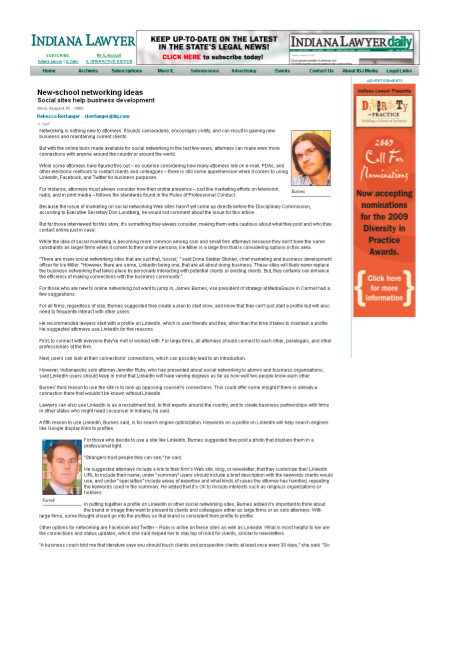
Farrell also goes to networking events – “tweetups” – of others on Twitter. While he doesn’t think other attorneys have attended those meetings, he has met a number of business owners of various ages and experience.

Because business owners are on sites like Twitter, he said, it’s likely attorneys could benefit from connecting with them.

Twitter has also linked him to experts, and to large conferences where he was unable to attend but people in the conference were posting status updates.

While it’s not exactly the same, it can get the message out. For speakers, it can share their information with potentially hundreds or thousands of people beyond those in the room for the presentation.

While Farrell said he felt like “the only guy in the goldmine” by using Facebook and Twitter, he recommended it for all attorneys regardless of experience level for the benefits he has seen.

Click the images below to read the full article.

Picture 1Picture 2

Source: Indiana Lawyer, Vol. 20, No. 11


Blog Author Featured in Indiana Lawyer Article

06 Thursday Aug 2009

Posted by Kenan Farrell in Indiana, KLF Legal, Tech Developments

≈ Leave a comment

Check out this excerpt from an article in the current issue of the Indiana Lawyer (an IBJ Media publication), featuring none other than the author of the Indiana Intellectual Property & Technology Law Blog:

New-school Networking Ideas

…To help avoid having potential clients see personal information, attorneys on Facebook can also set up business profiles for their firms, which are separate from personal pages.

Kenan Farrell, a solo attorney in Indianapolis who represents artists and musicians among his list of intellectual property clients, said he has had success through his Facebook business page, Facebook ad – charged on a pay-per-click basis – and Twitter.

After he worked for a large firm in Indianapolis, he moved to San Francisco, then moved back to Indianapolis where he started his own firm in January.

He said it’s because of social networking that he’s been able to get “good, interesting work from clients” for much less than it would cost to have an ad on television or in the phone book, something he investigated when he decided to become a solo practitioner.

IndianaLawyerPictureSo far, most of the other attorneys on Facebook and Twitter he is connected to practice outside of Indiana. Those connections have resulted in business when lawyers in other states need local counsel or know someone who does.

Farrell also goes to networking events – “tweetups” – of others on Twitter. While he doesn’t think other attorneys have attended those meetings, he has met a number of business owners of various ages and experience.

Because business owners are on sites like Twitter, he said, it’s likely attorneys could benefit from connecting with them.

Twitter has also linked him to experts, and to large conferences where he was unable to attend but people in the conference were posting status updates.

While it’s not exactly the same, it can get the message out. For speakers, it can share their information with potentially hundreds or thousands of people beyond those in the room for the presentation.

While Farrell said he felt like “the only guy in the goldmine” by using Facebook and Twitter, he recommended it for all attorneys regardless of experience level for the benefits he has seen.

Click the images below to read the full article.

Picture 1Picture 2

Source: Indiana Lawyer, Vol. 20, No. 11

← Older posts
Newer posts →

Categories

  • Advertising Law (1)
  • Artists (23)
  • Authors (20)
  • Bloggers (37)
  • Branding (29)
  • Business Law (9)
  • Copyright (327)
  • Dear KLF Legal (4)
  • Defamation (5)
  • Entertainment Law (14)
  • Estate Law (2)
  • Family Law (2)
  • Fashion (5)
  • Federal Initiatives (33)
  • Indiana (603)
  • Indianapolis (51)
  • Intellectual Property (662)
  • Just for Fun (25)
  • KLF Legal (19)
  • Legislation (34)
  • Litigation (595)
  • Musicians (13)
  • Nonprofit (6)
  • Northern District of Indiana (215)
  • Patent (44)
  • Privacy (15)
  • Right of Publicity (8)
  • Social Media (56)
  • Southern District of Indiana (369)
  • Stories from the Week that Was (42)
  • Supreme Court (13)
  • Tech Developments (119)
  • Trade Dress (26)
  • Trade Secret (15)
  • Trademark (363)
  • What I'm Reading (8)

Bloggers Copyright Federal Initiatives Indiana Indianapolis Intellectual Property Legislation Litigation Northern District of Indiana Patent Social Media Southern District of Indiana Stories from the Week that Was Tech Developments Trademark

Blog at WordPress.com.

  • Subscribe Subscribed
    • Indiana Intellectual Property Blog
    • Join 81 other subscribers
    • Already have a WordPress.com account? Log in now.
    • Indiana Intellectual Property Blog
    • Subscribe Subscribed
    • Sign up
    • Log in
    • Report this content
    • View site in Reader
    • Manage subscriptions
    • Collapse this bar
 

Loading Comments...